

In a market where franchise networks must navigate the diversity of retail locations, performance pressures, and the data explosion, dynamic benchmarking has emerged as a key driver of transformation.
This is the message conveyed by Benoît Fougerais (FM Lending) and Carine Fotso (IQO) during a webinar focused on data for franchise networks.
Contents
1. Data: From a Burden to a Business Driver
Today, organizations collect a vast amount of information (sales, human resources, customer satisfaction, tool usage, etc.), but this data is often unstructured and difficult to analyze. Teams are overwhelmed by Excel spreadsheets and struggle to identify the true drivers of performance.
Today, a huge amount of data is collected, but without proper structuring, it remains a burden… our role is to help networks move from passive data collection to useful data.
Carine FOTSO, Partner at iQo, Data & AI Expert
For iQo, three pillars are essential:
- Standardize the data for each franchisee
- Automate data collection and improve data reliability
- Leveraging Data with Relevant and Comparable Metrics
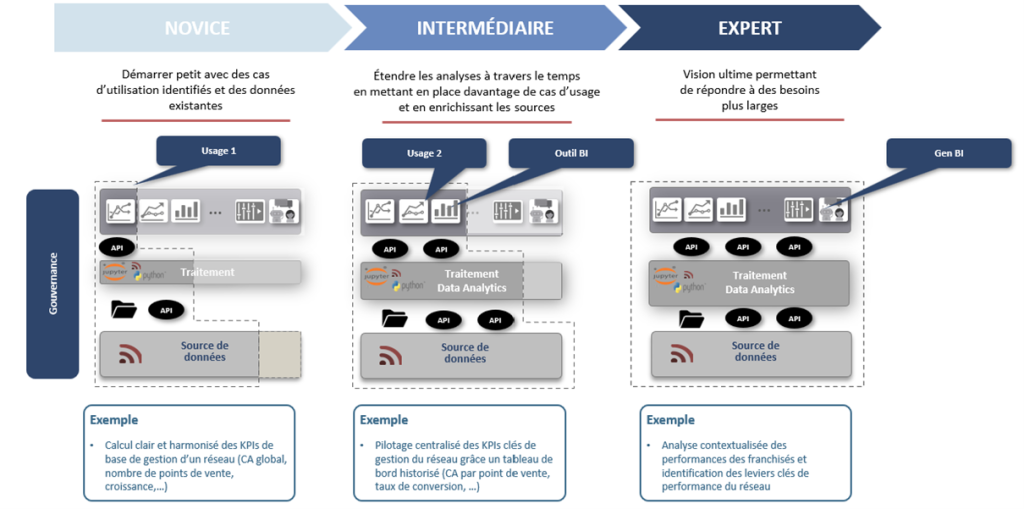
A process that can be applied regardless of the network's level of maturity.
2. Dynamic benchmarking: A Break from Traditional Reporting
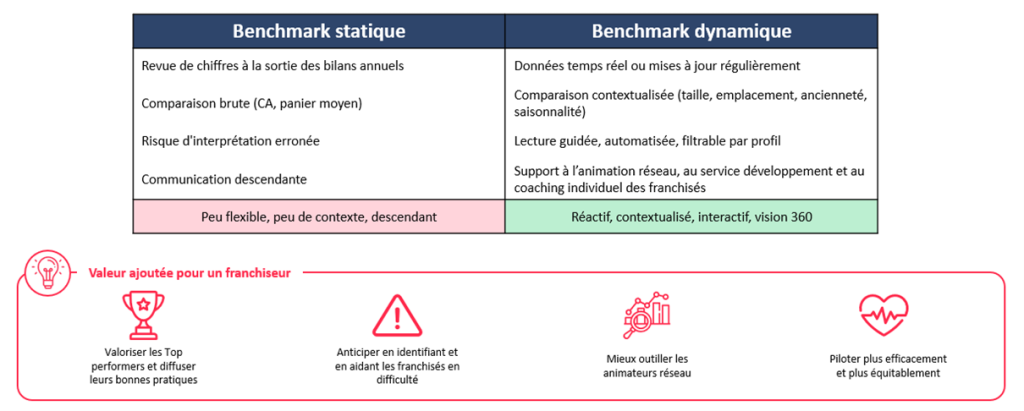
- a dynamic, up-to-date view, potentially in real time
- a contextualized analysis (CA1 vs. m², CA vs. enrollment, tool usage rates, etc.)
- intelligent comparisons, not crude ones
- visibility accessible to all levels of the network
What's interesting about dynamic benchmarking is that it can be used by every level of the organization—management, operations, franchisees, and so on—and everyone can drill down to the level that matters to them.
Benoit FOUGERAIS, FM Lending
This way, a franchisee can see where they stand within the network (e.g., 3rd in average basket size, 8th in payroll as a percentage of revenue) without accessing confidential data from other locations.
The coordinator, for their part, can immediately identify the top performers in each category to share their best practices, or franchisees facing challenges so they can provide targeted support.
3. The Decisive Contribution of AI: Toward “Generative BI”
The new generation of generative AI tools now makes it possible to query data using natural language to automatically generate analyses, visualizations, reports, explanations, and recommendations based on a company’s data. This is known as Generative BI: Business Intelligence enhanced by generative AI, capable of transforming a simple question into actionable insights that are accessible to everyone, without the need for technical expertise.
With the new Generative BI tools, anyone can analyze their data. It’s now up to each individual to manage their numbers and know how to interpret them to improve performance.
Carine FOTSO, iQo
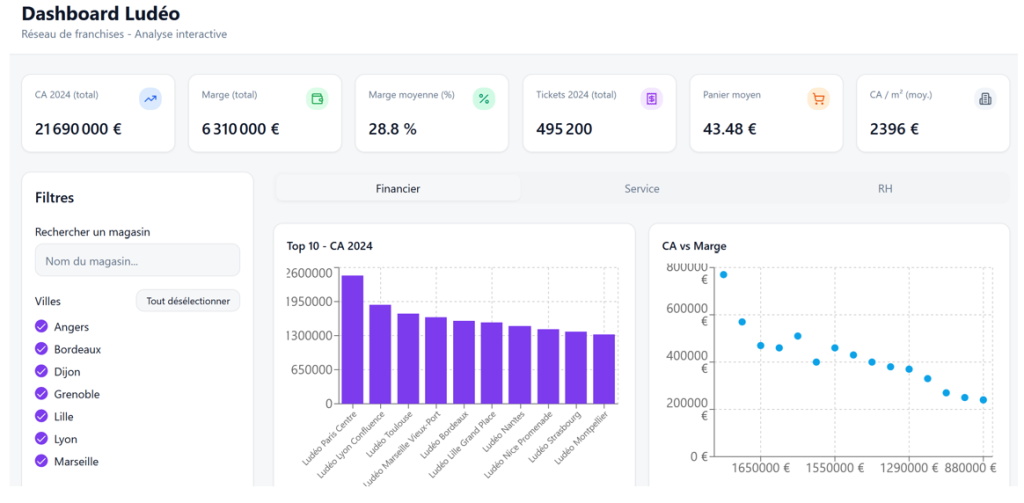
- the automatic creation of dashboards
- Generating Custom Metrics
- Instant access to definitions and formulas
- access to the code (SQL, Python) for scaling up as needed
4. A Real-Life Example: A Creative Leisure Network Losing Visibility
- performance gaps that are difficult to explain
- Managers Swamped with Excel Reports
- lack of historical perspective
- inability to identify the key drivers (sales, foot traffic, HR, operations, etc.)
- a 360° view of its business
- contextualized comparisons
- network-based coordination grounded in facts, not intuition
5. A Direct Impact: Productivity, Performance, Royalties
- Team Productivity: Less time spent on Excel data processing, more time dedicated to providing support.
- Franchisee Performance: Concrete best practices, identified and disseminated quickly.
- Optimized payroll: Cross-referenced metrics make it possible to align resources with business activity.
- Increase in Royalties for the Franchise Head Office: Helping franchisees generate more revenue automatically leads to an increase in royalties.
- Controlled and phased budget: Projects can start “small,” building on what already exists (even a simple Excel spreadsheet), and then scale up.
Conclusion: A Tool for Transformation Accessible to All Networks
Dynamic benchmarking is not limited to mature networks. It is now accessible to everyone, regardless of the size or complexity of the ecosystem.
With the rapid advancement of AI technologies, networks now have powerful tools to better manage, coordinate, and perform.
To do this:
- Start with a simple discussion to assess the current situation.
- Identify ways to boost productivity (automate time-consuming tasks, streamline processes, effectively organize the data pipeline, etc.)
- Move forward step by step, based on available resources and needs.
Building on the dynamic benchmark developed by iQo, FM Lending proposes adding a key component: standardized financial analysis of franchisees. Franchise networks are expressing a growing need to understand, compare, and anticipate the financial performance of their franchisees.
FM Lending consolidates the balance sheets, income statements, and interim management reports for each retail location to generate comparable KPIs2, reliable segment ratios, and a unified financial view of the network.
This standardized data naturally feeds into the IQO dynamic benchmark: it makes it possible to identify franchisees facing difficulties, pinpoint best financial practices, and provide network management with 360° oversight that finally incorporates the financial dimension.
Together, we enable franchise networks to move from a fragmented view to a comprehensive, dynamic, and actionable understanding of their performance.
Data has never been more accessible. It’s time to turn it into a source of competitive advantage for your network.

Data Fundamentals Training
Data is often referred to as “black gold,” but beyond the buzzword, it’s really about understanding what it is, how it flows, and how to derive value from it

Self-Service BI in the Era of the Modern Data Stack
Self-service BI marks the democratization of data access, enabling non-technical users to make real-time decisions through immediate and accessible analytics. Discover the

Opening up data assets with an AI agent: challenges and steps
While it may seem like a long way to go before you can deploy an AgentAI on your data assets, many companies already have sufficient data assets, but they are often poorly organized, poorly managed and poorly managed.