Today, agent-based AI enables companies to take a major step forward in implementing new applications across their business lines. It allows employees to delegate part of their work to automated assistants that operate autonomously within the company’s ecosystem, while remaining under their control.
Raphaël Peyrau, founder of the startup SYNIA, which specializes in implementingcustom AI agents , visited IQO to exchangeon the various use cases AI thatoare deployed din the companies.

Summary
Artificial intelligence is entering a new phase: following experiments with generative AI, companies must now move toward the industrial-scale deployment of AI agents. The SynIA approach illustrates this transition by structuring the move from prototype to operational deployment of agent-based AI capable of acting, making decisions, and orchestrating business processes autonomously. The challenge is no longer purely technological: it involves ensuring data governance, integrating AI agents into existing systems, and creating business use cases that truly drive performance. By combining methodology, architecture, and organizational support, SynIA offers a concrete framework for transforming the promises of agent-based AI into sustainable industrial value.
Contents
1. Moving from Conversational AI to Proactive AI
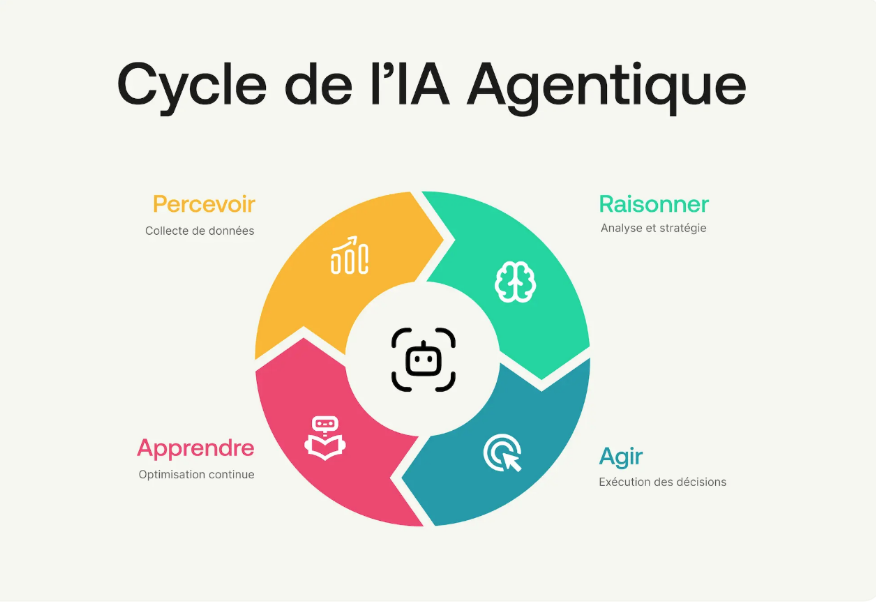
Agent-based AI goes beyond the chatbots that have been part of infrastructure for the past few years by combining a reasoning engine (LLM), the ability to access domain knowledge (documents, repositories, data), and action tools (APIs, RPA, internal applications) to execute a task from start to finish, under controlled conditions.
The main issue is finding the right interface to ensure that humans and machines work together as effectively as possible, because there is an inherent limit of at least 5% in the rate of hallucinations in LLMs
This conference highlighted the complementary nature of SYNIA and iQo: on the one hand, cutting-edge technological expertise in the design of custom AI agents; on the other, the ability to define business needs, structure transformation pathways, and support the widespread adoption of these solutions within organizations. It is this combination that makes it possible to move beyond the prototype stage and turn agent-based AI into a true operational driver.
Carine FOTSO, Partner at iQo, Data & AI Expert
The AI agent understands the request, develops a plan, and then executes actions (or prepares them) within a defined scope. The goal is not “total” autonomy, but the ability to act in a reliable, traceable, and secure manner.
AI agents are built around three building blocks:
-
Comprehension:
—understanding the intent, rephrasing, clarifying the request -
Decision:
—find relevant information, reason, and propose a plan -
Action:
call tools, produce a deliverable, track, and report
2. Choose the Right Use Cases for Your AI Agents: Rapid Value, Continuous Improvement
The most relevant use cases often share the same characteristics: a repetitive and time-consuming process for teams, scattered information that increases processing time, deliverables that can be standardized, and measurable value (time, quality, compliance, satisfaction).
SYNIA’s approach is pragmatic: start with a business pain point, prototype and deliver, measure and improve, and then scale up. The goal is to quickly demonstrate to the client the added value of the agent-based system for its teams, before enhancing the tool and rolling it out on a large scale.
At SYNIA, we offer our clients a comprehensive AI integration strategy spanning 2 to 3 years, designed to build their AI workforce of the future and maximize efficiency.
Raphaël PEYRAU, founder of SYNIA
It is precisely in this context that the synergy with iQo really comes into its own. While SYNIA provides the ability to rapidly design and deploy operational AI agents, iQo steps in to structure the end-to-end process: identifying business pain points, prioritizing use cases based on their value, defining target processes, engaging teams, and establishing the conditions for scaling up.
3. Architecture and Governance: The Key to a Controlled and Sustainable Deployment
The industrialization of agent-based AI does not rely solely on the technical performance of the agents.
During its projects, SYNIA’s primary challenge is to clearly identify the client’s needs and understand how to implement a system capable of meeting them, while taking into account the company’s constraints: accessibility, governance, quality control, data confidentiality, solution maintenance, etc.
It is based on these aspects thatiQo and SYNIA are developing a shared approach: designing agents that are useful, but also ensuring they can be adopted, managed, and sustained within the company’s ecosystem.
-
Access and security:
granular access control (who can view what, who can do what) and separation of environments. -
Traceability:
logging of actions, justification of responses, retention of evidence. -
Quality:
tests, assessment exercises, error tracking, continuous improvement. -
Costs:
managing consumption, selecting models, optimizing tool calls.

Training: Generative AI and AI Agents
Discover this training program, which combines foundational knowledge, real-world insights, and hands-on exercises (including the coordination of a first-line agent), to give participants a solid foundation for taking action today while preparing for future changes.
4. Making Agent Technology Tangible: Examples of AI Agents in Business
To make the presentation more concrete, Raphaël shared a few examples of AI agents that SYNIA has deployed for its clients:
-
Automated invoice verification:
data extraction, validation, anomaly detection, and report generation. -
Accelerating business analysis:
—source gathering, structured summarization, comparison, and recommendations. -
Generating field reports:
—organizing observations and producing a document in the required format.
5. The Value of the iQo x SYNIA Partnership
The partnership between iQo and SYNIA covers the entire value chain of an agent-based AI project: from identifying business pain points to large-scale deployment.
- SYNIA provides technological expertise in AI agents: understanding user needs, designing agent-based systems, integrating them with business tools, and rapid prototyping.
- iQo brings complementary expertise in business context, data and AI strategy, data governance, quality, compliance, process transformation, and change management.
This combination makes it possible to move from a proof-of-concept (POC) approach to a production-scale approach : prioritized, secure use cases that are adopted by the teams and managed over the long term.
Conclusion: A Simple Path to Industrializing Agent-Based AI
In conclusion, this conference highlighted agent-based AI as a new way toindustrialize AI : assistants capable of understanding, reasoning, and acting within a controlled environment.
Value does not come from the complexity of the system, but from a thorough understanding of customer needs, a tailored architecture that secures access to data and tools, and safeguards that ensure traceability, compliance, and quality.
Our goal is to apply our understanding of what is technologically feasible to support companies based on their processes and to prioritize use cases with the best ROI.
Raphaël PEYRAU, founder of SYNIA
Through this conference, iQo and SYNIA share a common conviction: agent-based AI becomes a true operational driver when it supports teams, is well-designed, and is integrated into corporate ecosystems.
By combining SYNIA’s technological expertise with iQo’s transformation approach, companies can chart a pragmatic and controlled path toward the industrialization of their AI applications. The goal is not only to create high-performing agents, but also to foster a new operational capability that supports teams, business functions, and sustainable performance.

AI Consulting Firm
As a strategy and transformation consulting firm, iQo places AI at the heart of its business model. Understanding all the challenges of AI today, while providing our clients with the right AI tools, is central to our approach. We place AI at the heart of a hybrid consulting approach to deliver concrete, results-oriented solutions.
Frequently Asked Questions
What Is Agent-Based AI in Business?
Agent-based AI refers to a new generation of artificial intelligence capable of acting autonomously to achieve a business objective. Unlike traditional AI models that respond to a query, AI agents can plan actions, interact with multiple systems, and execute complete processes.
Why move from an AI prototype to industrial-scale production?
What are the major challenges in the industrialization of agent-based AI?
How does a structured approach like SynIA facilitate the deployment of AI agents?

Agent-Based AI: How AI Agents Are Revolutionizing Automation and Governance
We are now entering a new era: that of agent-based AI. We are moving from AI that “talks” to AI that “acts.” This transition is not limited to

5 Ways AI Can Drive Business Transformation
What are the five main applications of Artificial Intelligence, and what is their strategic impact on businesses? Our Data & AI experts share their insights. Table of Contents Artificial Intelligence (AI)
Successfully Scaling Your AI Projects
These days, scaling up is the watchword for every artificial intelligence initiative. Indeed, the value proposition offered by this technology is driving