Customer Experience Consulting
We help organizations design meaningful, seamless, and distinctive experiences at every stage of the customer journey by integrating strategy, design, data, and transformation.

Customer Experience Consulting Firm
The customer experience is no longer limited to the quality of service provided: today, it shapes brand perception, customer loyalty, word-of-mouth recommendations, and long-term value creation.
In an environment characterized by omnichannel customer journeys, higher expectations, and faster decision-making, companies must orchestrate simple, consistent, and personalized interactions while balancing operational efficiency, relationship quality, and cost control.
Customer experience consulting specifically helps align vision, customer journeys, organizational structure, feedback mechanisms, and management practices to create experiences that are truly valuable for both customers and teams.



Key Issues in Customer Experience
Designing Consistent Experiences in an Omnichannel World
Customers are constantly moving between physical, digital, and relational channels. The challenge is no longer to optimize a single touchpoint, but to ensure a seamless customer experience across channels, with the right level of fluidity, personalization, and recognition.
Turning Simplicity into a Competitive Advantage
Customer experiences that are too complex lead to frustration, confusion, and churn.
Organizations must simplify customer journeys, messaging, offerings, and interactions in order to reduce friction and improve both customer satisfaction and internal efficiency.
Making Better Use of Customer Feedback to Guide Decision-Making
Companies have access to an increasing amount of feedback, verbatim comments, and behavioral cues, but still struggle to turn them into concrete decisions.
The challenge is to organize a continuous, actionable customer feedback process process that is continuous, actionable, and aligned with business priorities.
Aligning the Brand Promise with the Actual Experience
Many organizations invest in their brand messaging, but the experience they deliver doesn't always live up to that promise.
The challenge is to align positioning, customer journey, service, tools, and interpersonal approaches to create a credible, consistent, and distinctive customer experience.
Embedding a Customer-Centric Approach in Business Transformation
The customer experience cannot rely solely on a CX team or customer relations.
It requires a more profound transformation of operating practices, governance, metrics, and trade-offs so that customer needs truly influence decisions.
52 %
64%
41%
additional revenue growth for customer-obsessed organizations, 49% faster profit growth, and 51% better customer retention than others.
Why Is It Time to Revamp Your Customer Experience?
AN APPROACH THAT IS TOO FOCUSED ON INTERNAL CHANNELS OR SILOS
This fragmentation prevents companies from addressing real breaks in the customer journey and dilutes accountability for the customer experience.
A CUSTOMER EXPERIENCE DESIGNED FROM AN ORGANIZATIONAL PERSPECTIVE RATHER THAN FROM A USER PERSPECTIVE
The result: complex interactions, redundancies, unnecessary effort for the customer, and a promise of simplicity that is rarely kept.
A CHALLENGE IN MOVING FROM DIAGNOSIS TO ACTION
Without clear governance or a defined approach, the customer experience remains more of an aspiration than a reality.
A CUSTOMER-CENTRIC APPROACH THAT IS NOT FULLY EMBEDDED IN MANAGEMENT
Transformation requires visible commitment from leadership and buy-in from all teams.
Our Approach to the "
"
Customer Experience Consulting
Customer Experience Strategy
Customer Experience Strategy: Defining a clear experience visionthat is consistent with the brand promise, customer expectations, and the company’s business objectives.
Customer Experience Maturity Assessment: Evaluate the organization’s ability to design, manage, and improve the customer experience through its governance structure, feedback mechanisms, customer journeys, and operational practices.- Target Vision and Experience Principles
Formalize a vision of the experience to be delivered, along with guiding principles and transformation priorities, in order to align teams around a common goal. - Prioritizing the Moments That Matter
Identify the moments of truth, major pain points, and opportunities that have the greatest impact on satisfaction, loyalty, and value creation. - CX Roadmap
: Develop a realistic improvement plan aligned with business priorities, operational constraints, and required investments.
EXPERIENCE DESIGN
- Experience Design
Designing desirable, useful, and consistent experiences based on customers’ behaviors, expectations, and emotions. - User Research and Fieldwork
: Understanding customer behaviors, needs, pain points, and trade-offs through interviews, observations, workshops, and qualitative analysis. - Personas and Key Needs
: Develop a shared understanding of customer profiles, their expectations, and their usage contexts to guide design decisions. - Experience Concepts and Target Scenarios
Envisioning future experiences, target journeys, and relationship scenarios aligned with the company’s value proposition.
Prototyping and Testing: Rapidly test ideas, interfaces, services, or relational mechanisms to validate design choices before deployment.
Improving the Customer Journey
- Improving Customer Journeys
Optimize end-to-end journeys to reduce friction, streamline interactions, and increase perceived value for customers. - Mapping Current Customer Journeys
Identify the stages, touchpoints, emotions, pain points, and disruptions to continuity in order to objectively assess the actual customer experience.
Pain Point Analysis: Identify the root causes of the challenges customers face and measure their impact on conversion, satisfaction, engagement, and retention.- Redesigning Priority Customer Journeys
Rethinking high-stakes customer journeys—acquisition, onboarding, complaints, self-service, retention, etc.—to simultaneously improve both the customer experience and business performance. - Managing Continuous Improvement
Establish metrics, routines, and learning loops that enable the adjustment of learning paths over time.
customer feedback
Customer Feedback: Structuring a continuous and actionable feedback process to capture customers’ actual expectations and inform business decisions.- Customer Voice and Listening Architecture
Identify the most relevant sources, listening opportunities, metrics, and data collection channels based on customer journeys and business challenges. - Analysis of Transcripts and Faint Signals
Leverage customer feedback, complaints, surveys, interactions, reviews, and behavioral data to identify trends, recurring pain points, and opportunities for action. - Closed-loop feedback
Establish mechanisms for processing, prioritizing, and providing feedback to teams to turn listening into concrete decisions. - Customer Knowledge Governance
Share insights at the appropriate organizational level to empower business units, strengthen alignment, and accelerate decision-making.
Customer-oriented transformation
- Customer-Centric Transformation
Evolving the organization, decision-making processes, and practices to ensure that the customer’s voice is permanently embedded in our actions. - CX Organization and Governance
: Clarify roles, responsibilities, governing bodies, and management processes to prevent initiatives from becoming fragmented and to accelerate execution. - Customer Culture and Acculturation
Develop common approaches, rituals, and reference points to foster a culture of active listening, empathy, and continuous improvement. - Aligning Metrics and Performance
Evolving the KPIs, dashboards, and decision-making criteria to link customer satisfaction, operational efficiency, and business results. - Change Management
Supporting teams and managers as they adopt new practices so that customer focus becomes a collective habit rather than a one-time initiative.
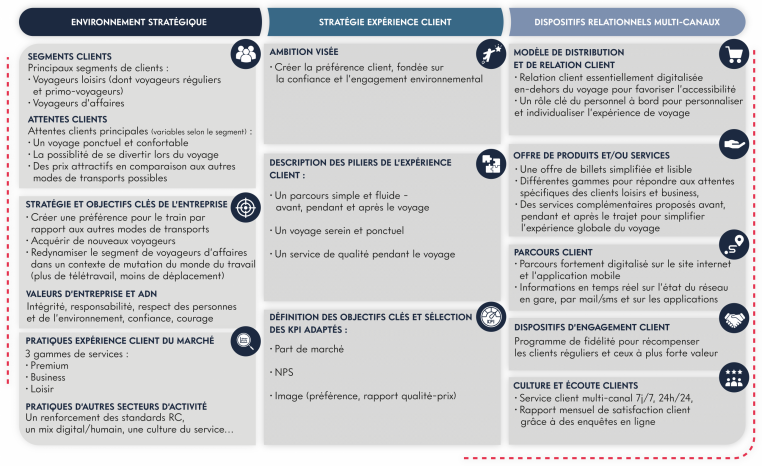
CX-iD: iQo's Methodology for Defining Your Customer Experience
To make it easier to define a customer experience strategy, we have developed a framework that is easy to use and adaptable to any environment. It is called CX-iD by iQo.
This methodology, developed by iQo, makes it possible to:
- describe the strategic environment: customers, strategy, the external environment, and the competitive environment;
- Describe the customer experience strategy: a vision, pillars that answer the question “What would I like my customers to say about me?”, and objectives;
- Describe the relational mechanisms that will effectively support this strategy: the distribution model, the product offering, customer journeys, and mechanisms for customer engagement and culture.
Success stories
Check out our case studies on customer experience consulting projects—
—recently carried out by our teams.
Defining a Pharmaceutical Group's Customer Experience Strategy
iQo worked with the Executive Committee to define a three-year customer experience strategy
- Defining the goals to be achieved in light of the market and the company’s strengths
- Translating this ambition into actionable operational strategies
- Defining Key Performance Indicators (KPIs) to Achieve
- 3-Year Roadmap
Outline of the Customer Care Program for a Leading Transportation Company
iQo worked with the Sales and Marketing Department to define the “Customer Care” pillar of the new strategic plan.
- Multisector Benchmark
- Definition of key initiatives, goals, and associated objectives
- Defining the Implementation Path
Definition of a Leading Insurance Company's Customer Feedback System
iQo worked with the Marketing Department to define the target customer feedback framework (B2B, B2C, B2B2C)
- Internal Assessment and Maturity Analysis in the Insurance Sector
- Target Device Recommendations by Customer Segment
- Implementation Support
Our Publications on
: Customer Experience Strategy
Our Customer Experience Strategy Consulting teams frequently publish articles
to analyze and interpret key trends.

Once & Done (FRC): Definitions and Calculation Methods for a Key Customer Experience KPI
FRC—First Contact Resolution, or “once & done”—is a widely used metric in customer relationship management systems. It aims to

Customer Experience in New-Construction Real Estate: A Necessary Transformation in a Changing Market
The new residential real estate market has historically been driven by one key factor: private rental investment, supported by tax incentives. This foundation has shrunk dramatically, profoundly altering the structure of

The customer relations professions of tomorrow in insurance
Customer service roles in the insurance industry must reinvent themselves. In this article, discover an overview of some inspiring initiatives. Summary: Customer service roles in the

3 steps to measuring Customer Experience ROI
The customer experience, like other aspects of marketing and customer relations, needs to be measured to assess ROI. Our experts give you the 3 steps to
How can iQo support you?
iQo is a strategy and transformation consulting firm whose mission is to “unleash collective genius to co-create desirable futures.”
- Our firm offers a unique approach to co-construction with our customers.
- We advocate for the integration of skills and expertise, with a particular focus on AI and Impact at the heart of our approach.
- We offer small, agile teams that are genuinely committed to working alongside you, acting as an extension of your own teams.
- We are "makers" and offer practical, results-oriented solutions tailored to your specific
needs. - We are committed: iQo is a mission-driven company that is Ecovadis Gold, ISO 9001, and ISO 14001 certified.
FAQ - Customer Experience Consulting
What is a customer experience strategy?
How to Develop an Effective Customer Experience Strategy?
The process begins with an analysis of customer expectations, business objectives, and the competitive landscape. It continues with the definition of a strategic vision, customer experience pillars, key performance indicators (KPIs), and an action plan implemented across all customer journeys and touchpoints.
Learn more about our customer experience consulting services here.
Why hire a customer experience consulting firm?
A customer experience consulting firm helps companies define a customer-centric strategy, improve customer journeys, optimize customer relationships, and transform their organizations. Its goal is to enhance customer satisfaction, loyalty, and business performance through a structured and measurable approach.