AI Assistant or AI Agent? Discover the practical differences between them, their uses in business, and how to successfully transition to a well-managed agent-based organization.

Summary
Used as co-pilots, AI assistants improve individual productivity by helping users draft documents, analyze data, or search for information. However, their logic remains essentially reactive: they respond to requests without fundamentally transforming business processes.
With the emergence of AI agents, a paradigm shift is underway. These systems no longer simply generate responses; they are capable of interpreting an objective, planning actions, and coordinating various tools or data sources to execute a complete workflow.
This trend paves the way for the agent-based enterprise, in which autonomous agents take on an increasing share of operations, analyses, and certain decisions. It promises significant gains in productivity and automation, but also requires a rethinking of system architecture, human oversight, and the governance of automated decisions.
Contents
When AI Stops Assisting and Starts Acting
For years, artificial intelligence in the workplace was viewed as a tool for one-off optimization—a way to save time, automate certain repetitive tasks, and marginally improve individual productivity.
Then came generative AI.
With it came a shift in perception: AI was no longer merely executing tasks; it was engaging in dialogue, reasoning, and making suggestions. Very quickly, companies began integrating AI assistants into their everyday tools, sometimes on a large scale. But a new phase is now unfolding.
This stage marks a more profound shift: AI is no longer limited to assisting humans; it is now capable of acting autonomously within a given framework. This is where the distinction between an AI assistant and an AI agent becomes critical.
Because behind these two terms—which are often used interchangeably—lie radically different approaches, both technologically and organizationally. Understanding this difference means understanding how a company can move from useful AI… to truly transformative AI.

Training: AI Agents
Discover this training program, which combines foundational knowledge, real-world insights, and hands-on exercises (including the coordination of a first-line agent), to give participants a solid foundation for taking action today while preparing for future changes.
AI Assistant and AI Agent: Two Fundamentally Different Approaches
AI Assistant
- reagent
- conversational
- has assigned shares
AI Agent
- slightly proactive
- automated
- handles specific tasks independently, but in a specific sequence
Agent-Based AI
- completely proactive
- automated
- automatically schedules the tasks to be performed
The AI Assistant: Responsive Intelligence at the Service of the Individual
Today, AI assistants are the most widespread form of artificial intelligence in the business world. They are designed to interact directly with users, providing them with context-specific, immediate, and controlled assistance.
In practical terms, an AI assistant always operates on the same principle: it waits for a human prompt, interprets a request, and then generates a response or suggestion. It takes no initiative on its own and never goes beyond the parameters set by the user.
That is precisely what makes it so strong… and what limits it.
A Co-Pilot for Everyday Life
In practice, the AI assistant has become an indispensable daily companion. It makes it easier to write content, speeds up information searches, summarizes complex documents, and helps organize one’s thoughts. In many cases, it reduces the cognitive load associated with peripheral work tasks.
In businesses, these assistants are often deployed quickly through simple interfaces that are integrated with existing tools. Their adoption is generally seamless, as they do not disrupt established workflows. The user remains in control, deciding when to use the AI and how to make use of its responses.
This approach yields immediate productivity gains, but these are primarily individual in nature. While there is an improvement in personal efficiency, there is no fundamental transformation of business processes. The assistant optimizes existing processes; it does not redefine them.
The AI Agent: Supervised Autonomy in Support of Business Processes
The AI agent is based on an entirely different logic.
It is no longer a reactive tool, but an autonomous agent capable of pursuing a goal without constant human intervention.
An AI agent receives a task—whether explicit or implicit—and then has the ability to plan actions, perform tasks, make conditional decisions, and interact with its digital environment. It can query databases, call APIs, trigger workflows, or cooperate with other agents.
This autonomy does not mean a lack of oversight. On the contrary, the agent operates within a strictly defined framework: business rules, scope of action, decision thresholds, and oversight mechanisms. But within this framework, it acts without direct human intervention.
It is precisely this capability that makes all the difference.
The AI agent handles part of the business process
The AI agent doesn't just help an employee—it takes over part of the business process.
In an HR context, for example, an agent can review applications, assess their suitability for a position, generate personalized responses, and prepare a shortlist. In an operational context, an agent can analyze visual or textual data, produce structured reports, and trigger corrective actions.
Whereas an assistant acts on request, an agent acts based on objectives. And this difference is crucial to the company’s transformation.
From Individual Use to Organizational Transformation
The true value of AI agents becomes apparent when they are no longer isolated but integrated into a coherent architecture. This is what is gradually leading to the emergence of the agent-based enterprise.
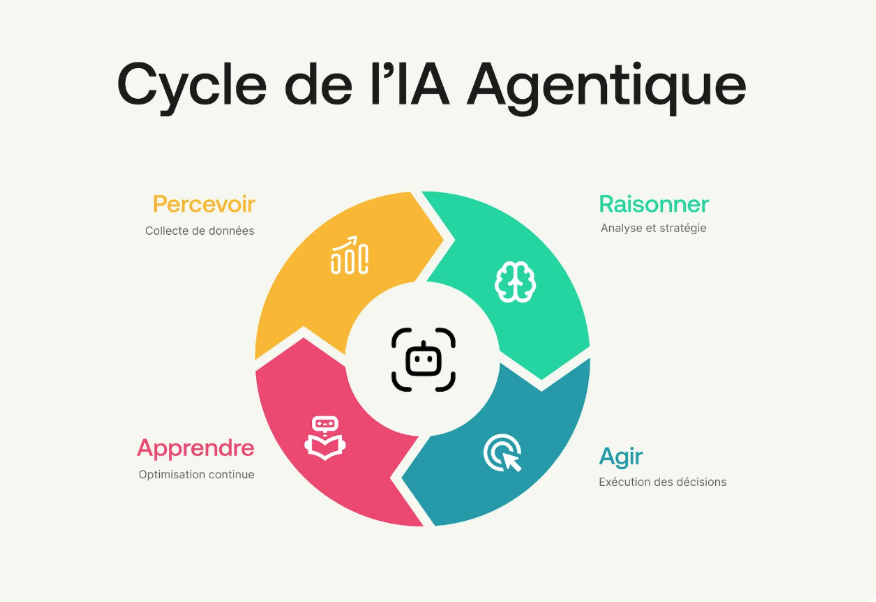
In this model, AI is no longer limited to individual assistance tools. It becomes an operational infrastructure capable of executing complete task chains, coordinating information flows, and ensuring continuity of action.
Employees continue to use AI assistants to boost their personal productivity. At the same time, however, specialized staff are taking over entire areas of the business: case management, monitoring metrics, quality control, and workflow management.
Humans do not disappear from the process. Their role changes. They define objectives, set rules, monitor results, and resolve complex situations. AI, on the other hand, handles execution and repetition.
A path toward maturity rather than a technological leap
Contrary to popular belief, a company does not become agentic overnight. This transformation is based on a gradual process of maturation that combines learning, experimentation, and strategic alignment.
-
The first step is understanding.
Before deploying autonomous agents, an organization must master the fundamentals of AI: what it can do, what it cannot do, the associated risks, and potential biases. Without this foundation, autonomy becomes a source of instability rather than value. -
Next comes experimentation.
The most advanced companies are those that test, learn, and iterate based on real-world use cases. They do not seek to automate all of their processes, but rather target situations where the autonomy of AI provides a clear and measurable benefit. -
Finally, there is the question of purpose.
An AI agent is valuable only if it serves an explicit business priority. The issue is not technological, but strategic: Which processes need to be accelerated, made more reliable, or simplified? Where does the autonomy of AI truly free up human time and energy?
Managing Agent-Based AI: From Experimentation to Implementation
The deployment of AI agents cannot be treated as a simple IT project. It is a dynamic system that must evolve alongside the organization and its challenges.
Kevin JEAN, Partner at iQo, Expert Tech for Business
Governance plays a central role here. It makes it possible to:
- define the scope of autonomy
- secure access to data
- clarify responsibilities
- establish appropriate oversight mechanisms
Without governance, autonomy becomes a risk. With the right governance, it becomes a driver of performance.
Acculturation is just as essential.
Training teams is not just about explaining how to use a tool, but about developing a new way of thinking about work—one focused on objectives, rules, and human–machine interactions. Structured methods, such as advanced prompting or task formalization frameworks, help ensure consistent usage and reduce misunderstandings.
Finally, impact measurement must be ongoing.
Time saved, fewer errors, smoother processes, and employee satisfaction: these metrics make it possible to train agents, prioritize improvements, and demonstrate the true value of AI beyond the novelty factor.
Conclusion: Controlled autonomy, serving humanity
The distinction between an AI assistant and an AI agent is not merely a semantic debate. It reflects two different visions of the role of artificial intelligence in business.
The assistant improves individual efficiency.
The agent transforms processes.
Together, they are shaping a more agile, responsive, and resilient organization—one in which AI handles operational complexity, allowing employees to focus on what truly makes a difference: decision-making, creativity, and judgment.
An agent-based company is not a company without people.
It is a company where AI autonomy is carefully designed, guided, and harnessed to serve a collective goal.
The transition to an agent-based enterprise cannot be improvised.
It relies on a clear understanding of the challenges, applications, and limitations of AI.
That is precisely the goal of our training program dedicated to generative AI and agent-based AI : to enable organizations to move from experimentation to controlled autonomy.

Agent-Based AI Training
Discover this training program, which combines fundamental concepts, real-world insights, and hands-on exercises.
Frequently Asked Questions About AI Agents
What is an AI agent?
An AI agent is an AI that does more than just generate content; it can act autonomously within a given environment. Specifically, an agent combines generative models with:
- action capabilities (API calls, execution of scripts or tools),
- orchestration (linking several steps or tasks),
- planning (deciding on the best sequence of steps to achieve a goal)
An AI agent is therefore capable of carrying out an entire workflow, such as analyzing data, querying an external database, and then automatically drafting and sending a report.
What is the difference between generative AI and an AI agent?
Generative AI produces content in response to a prompt (e.g., writing a text, generating an image).
An AI agent, on the other hand, goes a step further: it can make decisions, coordinate actions, and interact with other systems to achieve a goal from start to finish.
In summary: Generative AI creates, while the AI agent acts and executes.
How are AI agents reshaping my job?
AI agent orchestration creates value for your business by automating manual tasks and transforming them into intelligent workflows.
This results in significant time savings, fewer operational errors, faster decision-making, and the ability to standardize complex processes.
The result: a measurable ROI and a more agile and high-performing organization.

5 Ways AI Can Drive Business Transformation
What are the five main applications of Artificial Intelligence, and what is their strategic impact on businesses? Our Data & AI experts share their insights. Table of Contents Artificial Intelligence (AI)

Successfully Scaling Your AI Projects
These days, scaling up is the watchword for every artificial intelligence initiative. Indeed, the value proposition offered by this technology is driving

Acculturation to Generative AI: best practices to follow
An effective strategy for adopting Generative AI in the enterprise is based on two complementary components: responding immediately to concrete uses with the right tools, and acculturating teams to AI