

This article is the continuation of 4 mistakes in ERP / data repository implementation
Not every problem in the implementation of ERP projects and data repositories has the same preponderance for every company. So there's no simple guide to success. But ERP projects and data repositories are strategic and necessary to the Data Driven evolution of a company. Fortunately, it is possible to succeed with ERP and data repository projects, and we're going to detail the various elements you need to take into account before getting started. And if your project is already underway and encountering difficulties, nothing is lost, but the following practices should be implemented as soon as possible.
Contents
Data framing: a fundamental element, but all too often forgotten
Although data is now at the heart of many conversations, it is an element that is all too often forgotten when framing major transformation programs.
Knowing the steps to take in terms of data asset management before embarking on an ERP transformation is a key factor in the success of any project of this type.
The aim of data scoping is to provide a complete vision of the operating mode, including roles, processes, systems and data processing rules, in both automatic and manual mode. The aim is to provide a complete and up-to-date vision of the operation of the reference data perimeter (product, suppliers, prices, etc.) in question, which is as realistic and factual as possible.
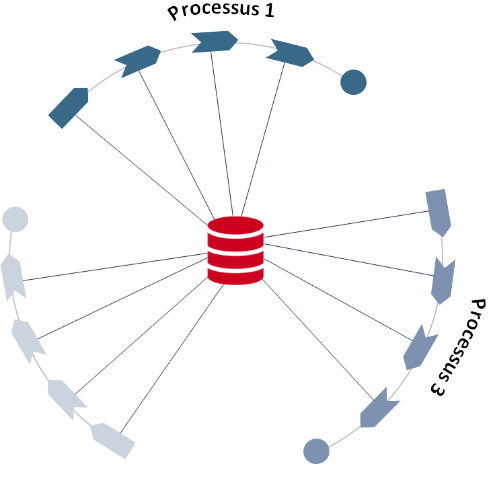
Our scoping methods use the principle of Data Process Management to explain and define existing business processes around data.
Our scoping methodology allows us to :
- understand the processes that will be involved and impacted by the project
- take into account the data used in these processes
- cross-reference these elements with the company's data maturity to identify the organization's difficulties.
Data scoping, by providing an exhaustive vision of current operations, from the creation of a product or service to its delivery to a consumer, will enable us to better define the areas of improvement to be covered in the target operations. When these elements are uncovered, the sticking points that lead to scheduling, quality and functionality problems will be better identified.
This data framework also aims to define and describe the data practices to be implemented:
- governance of data domains within the company (federated, centralized, etc.),
- DATA team organization,
- migration and data quality factories
- ...
The data scoping team: a cross-functional team that must remain available throughout the project
However, once the first elements have been identified, this data scoping unit should not disappear. The project, its shifts and changes in functional scope will require new cross-functional analyses and continuous improvement of the program's roadmap in this area. For this reason, the program needs to maintain its ability to set parameters to avoid any deadlock, and to be able to validate changes of direction by taking into account all data aspects.
Don't just focus on the target: secure every stage of the ERP project
Because of their complexity and length, ERP/Repository programs are broken down into several stages or milestones, including the various components of this type of project. Security consists in ensuring the nominal operation of the company at each stage of the program, and must be based on the updating of functional and data mappings.
This mapping is an indispensable solution for organizing the actions of each team and providing a precise vision of how intermediate milestones work, and of the gaps/inconsistencies that need to be filled in each process.
Linking up the various teams through data also brings greater cohesion, better communication on functional coverage and shortcomings, and thus creates transparency and user support.
This practice makes it possible to define the roles & responsibilities for data at each stage , and to define the actions required to maintain consistency at intermediate milestones.
In addition to this organizational coherence, data mapping enables us to define the means of controlling data between each stage. In an intermediate version, data discrepancies between two systems are quite frequent, as not all flows and processes are in place. This is a degraded mode, but one which nevertheless enables us to serve the company. It is essential to identify the data discrepancies that can be created and that need to be corrected before the target version, to ensure that no data is lost, which is a major irritant for users who have to change systems and are unable to retrieve the most recent data.
This last point requires the support of data analysis teams.
Set up a project analysis and reporting unit
Some ERP and data repository programs sometimes feel that they are sailing blindly along for lack of reliable indicators. The implementation of KPIs is too often relegated to the end of the schedule, making it difficult to analyze problems and define areas for improvement.
This type of program must therefore be equipped with a data analysis unit capable of answering various questions:
- Quality audit
- Validation of functional rules through data auditing
- Checking consistency between systems during changeover plans
An important task for this data analysis unit is therefore to ensure data consistency between the different systems, by implementing not only checks on the existence of records (customer, item...) between systems, but also the consistency of critical attributes, to ensure that the new system remains the point of information truth for the company.
This unit will be able to provide all the analytical elements needed to answer questions and provide factual information to the various business line managers, so that they can have a reliable vision of the data, and no longer work or trade on the basis of how the data is perceived.
In these few lines, we've drawn on our experience to present you with a few essential practices to implement on your projects. ERP / repository projects will always be complex, due to their cross-functional nature, but the success rate will be greatly improved by following these few tips.
Further information

4 errors in ERP / data repository implementation
There are many pitfalls to avoid when implementing ERP programs and data repository software. Here are 4 of them

Improving the employee experience thanks to data
At iQo, we draw on our experience in supporting organizations, employees and managers to turn data into an effective tool.

Data governance: definition and key principles
Data governance is a major lever for improving performance and accelerating business transformation. Indeed, today, data is an essential