Decarbonization has become a central issue for Procurement departments, which play a key role in the company’s emissions reduction strategy. Scope 3 emissions are indirect emissions resulting from suppliers’ activities. They often account for the largest portion of a company’s carbon footprint.
In this article, learn how Procurement departments should develop a strategy for decarbonizing Scope 3 emissions.
Contents
Scope 3 emissions: what are we talking about?
Greenhouse gas emissions are classified into three categories
- Scope 1: direct emissions from sources owned or controlled by the company.
- Scope 2: indirect emissions linked to purchased energy consumption.
- Scope 3: all other indirect emissions resulting from the company's activities, but from sources owned or controlled by other entities.
Focus on scope 3
Scope 3 is one of the three levels of greenhouse gas emissions established in the GHG Protocol (Greenhouse Gas Protocol). This protocol addresses greenhouse gases. It was launched in 2001 by the WBCSD (World Business Council for Sustainable Development) and the WRI (World Resources Institute).
Scope 3 of the GHG Protocol covers upstream and downstream emissions, providing a comprehensive view of a company's carbon footprint.
Downstream emissions
- product transport
- treatment of end-of-life products
- use of goods sold
- investments
- indirect emissions
Upstream emissions
- Procurement goods and services
- capital for transport
- waste management
- commuting to and from work
- indirect emissions
Proper categorization is essential for an effective emissions reduction strategy, with specific impacts depending on the sector of activity.
According to ADEME and GHG Protocol data, Scope 3 emissions can account for up to 90% of a company's total carbon footprint.
Guide: Scope 3 Decarbonization
- organize data collection
- evaluate and support suppliers based on standardized criteria in their decarbonization plan
- improve the reliability of GHG inventories
- pursue low-carbon pathways
Procurement s strategic role in scope 3 reduction
To reduce these emissions, a dedicated strategy, led by Procurement in collaboration with suppliers, is essential.
Procurement s have a decisive influence on Scope 3 emissions. Indeed, they manage relationships with suppliers and oversee spending. By incorporating sustainability criteria into their processes, they can drive significant change throughout the value chain.
Sustainable development—and, more specifically, decarbonization—is a major current issue for our clients. We must continue to support them and help them prepare for whatever challenges arise, particularly in terms of regulations. Procurement s departments also have a role to play in addressing biodiversity. They also have a say in eco-design and the circular economy.
Laura PERRES-GANNÉ, Partner at iQo

The benefits of a low-carbon Procurement strategy
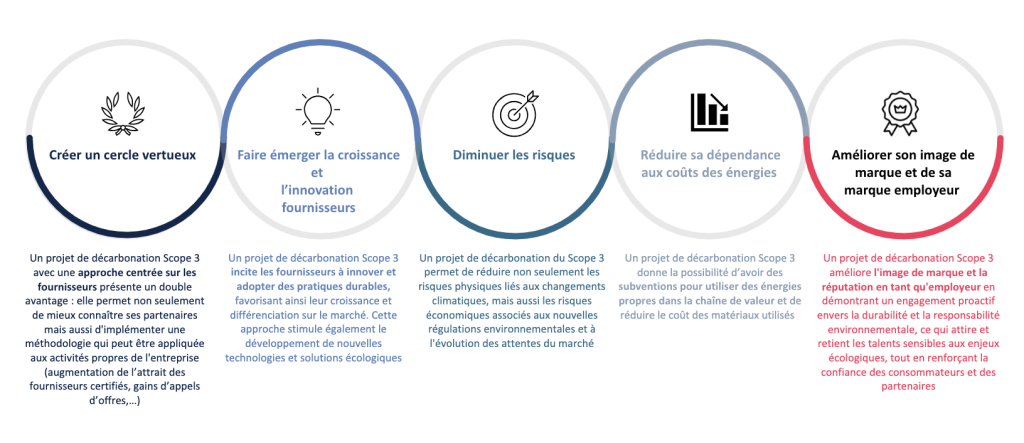
A Scope 3 decarbonization project with a supplier-focused approach offers a twofold benefit. On the one hand, it helps companies gain a better understanding of their partners. On the other hand, it also enables the implementation of a methodology that can be applied to the company’s own operations (increasing the appeal of certified suppliers, winning more bids, etc.).
Decarbonizing Scope 3 emissions encourages suppliers to innovate and adopt sustainable practices, thereby promoting their growth and helping them stand out in the market. In addition, this approach stimulates the development of new environmentally friendly technologies and solutions.
By definition, a Scope 3 decarbonization project helps reduce physical risks related to climate change. In addition, it helps mitigate the economic risks associated with new environmental regulations and changing market expectations.
The volatility of certain energy prices should serve as an incentive to pursue an active Scope 3 decarbonization policy. This can help secure subsidies for using clean energy throughout the value chain and reduce the cost of the materials used.
Through their scope 3 decarbonization project, companies are demonstrating a proactive commitment to sustainability and environmental responsibility. It's a factor that attracts and retains talent sensitive to ecological issues, while boosting consumer and partner confidence.
Our convictions to ensure the success of your scope 3 decarbonization strategy
1. Collaboration and commitment with employees must be continuous
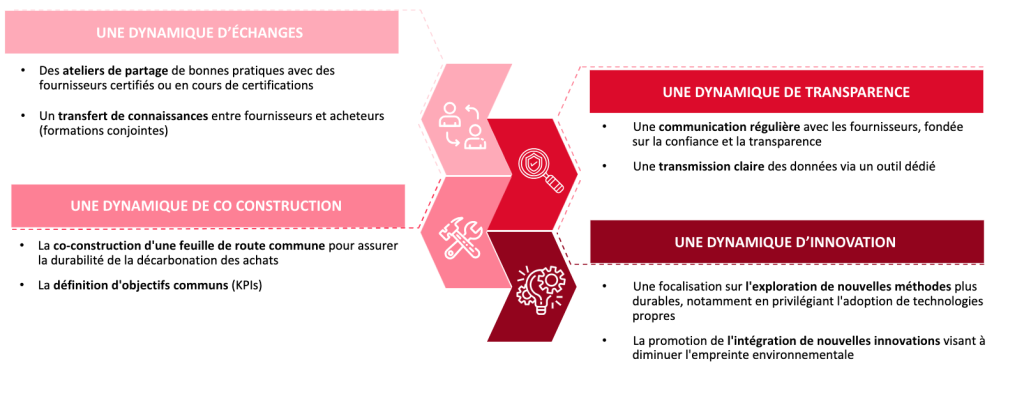
The success of a decarbonization strategy depends on the active, ongoing commitment of all those involved, especially suppliers. Close collaboration enables us to align our objectives with those of our suppliers, while empowering them to manage their own emissions and action plans.
Some ideas for action:
- Workshops to share best practices with certified suppliers or those in the process of certification
- Knowledge transfer between suppliers and buyers
- Co-construction of shared objectives and a common roadmap
- Regular communication based on trust and transparency
- Promoting the integration of new innovations to reduce environmental footprint
2. Give priority to physical data (based on declarations) over monetary data
The unit of measurement chosen (physical or monetary) has a huge influence on the quality of carbon reporting. Opting for physical data, supplied directly by suppliers, provides more reliable and accurate data for their assessments. Conversely, monetary data are more questionable in their translation into carbon weight.
3. Tools make enrolment and analysis easier
4. Ecological leadership and innovation are key success factors
Green leadership refers to a company's ability to guide and influence its activities, and those of its partners and stakeholders, towards more sustainable and environmentally-friendly practices.
Strong green leadership not only ensures that decarbonization practices are firmly anchored within the organization, but also facilitates the implementation and rigorous monitoring of the data needed to effectively steer the scope 3 decarbonization trajectory.
Ongoing training and enrolment of all employees ensures that these practices become part of the corporate culture. corporate culture and ensure maximum efficiency in implementing the decarbonization strategy.
Why call on iQo for your supplier decarbonization strategy?
As a consulting firm committed to sustainable transformation, iQo is uniquely positioned to support you in this endeavor.
- We benefit from recognized expertise in strategy ResponsibleProcurement strategy, particularly in the Energy and Utilities. iQo supports Procurement companies in their responsible and impactProcurement policies and strategies, and in supplier management (traceability, supplier data, Scope 3 ESG reporting, responsible supplier relations, etc.).
- We have solid references in CSR strategy We have a solid track record in CSR strategy: approach to labeling, CSR strategy, implementation of commitments and management indicators, innovation in CSRB-Leader and experience in labeling (Iso, B Corp, etc.) and transition to Mission Company status.
- We combine this know-how and experience with a pragmatic approach, enabling us to co-construct with our customers' teams a path adapted to their ambitions.
- We offer the ability to mobilize relevant expertise to broaden perspectives and opportunities: sector experts, Positive Impact, Data, AI...
Conclusion
Decarbonizing scope 3 is a complex challenge that requires the active involvement of Procurement Departments. By adopting a proactive, collaborative strategy, they can not only reduce their company's carbon footprint, but also strengthen the resilience and competitiveness of their supply chain in the face of today's environmental challenges.
Frequently Asked Questions
What is Scope 3, and why is it essential for Procurement ?
Scope 3 includes all indirect emissions associated with a company’s activities but generated by external partners (suppliers, logistics, product use, etc.).
It often accounts for the largest portion of an organization’s carbon footprint, making it a key area for action for Procurement.
What benefits does a low-carbon Procurement strategy bring to a company?
- Reduction of climate- and economic-related risks stemming from regulations and cost volatility.
- Encouraging innovation among suppliers to develop sustainable solutions.
- Enhancing brand image and employer brand through a visible commitment to sustainability.
What specific actions will improve the carbon footprint of the supply chain?
- Work closely with suppliers to jointly define reduction goals and plans.
- Prioritize physical data (actual emissions) over monetary data to ensure reliable reporting.
- Invest in technological tools to collect, analyze, and dynamically manage emissions.

What social strategy for banks and insurance companies?
Developing and implementing a social strategy is a key challenge and an asset for banks and insurance companies. It is even becoming a necessity in a macroeconomic, demographic, and social environment

Procurement responsible: how to take biodiversity into account?
Directorates Procurement, increasingly aware of biodiversity issues, are actively integrating these principles into theirProcurement responsible strategy. Find out how Procurement, at the heart

CSR labels: how can iQo help you?
Obtaining a CSR label can be a daunting task for companies who set out without a methodology. A specific CSR label attests to a company's or an organization's