
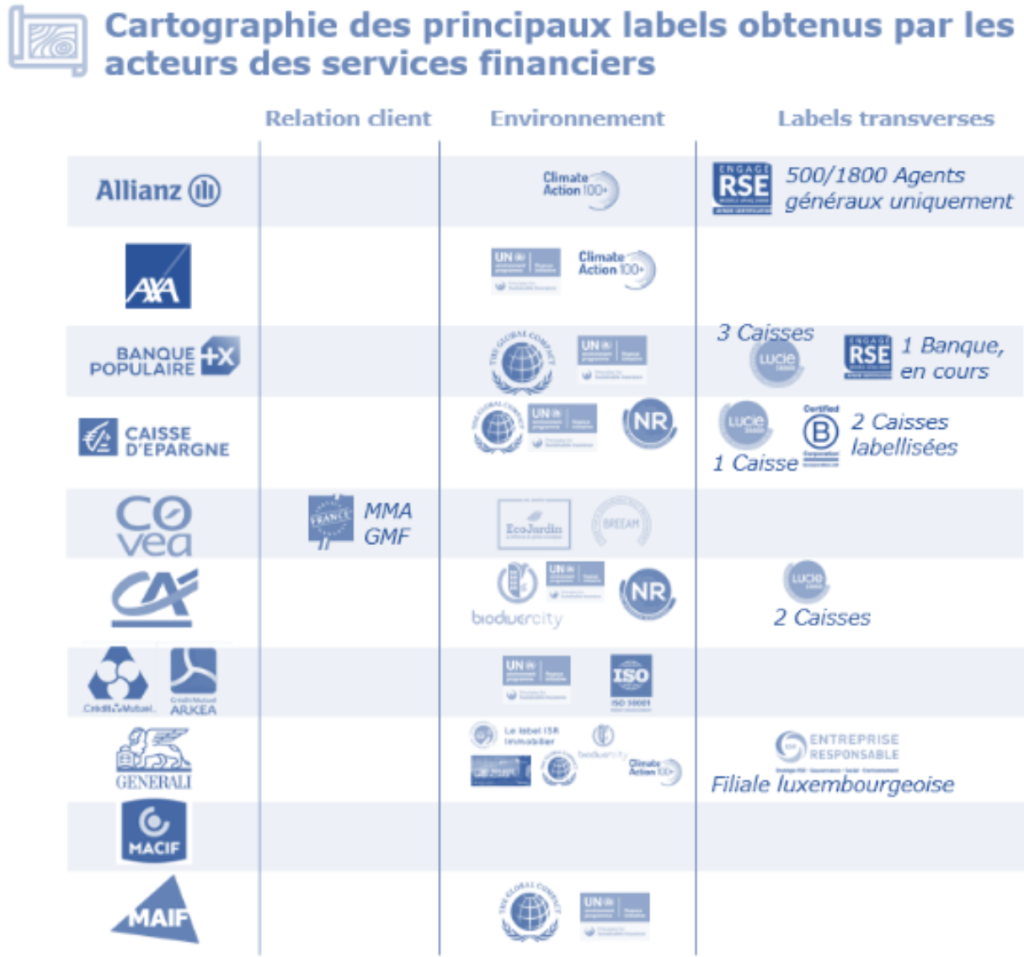

Obtaining a CSR label can be a daunting task for companies who set out without a methodology. A specific CSR label attests to a company's or product's compliance with a specific standard. After reviewing CSR standards and labels available to banks and insurance companieslet's take a look at the methodology to be adopted to obtain your CSR label.
Contents
iQo's convictions for obtaining a CSR label
Although CSR certification offers undeniable advantages, its implementation is not without its challenges. Faced with this complexity, iQo has positioned itself as a strategic partner for mutuals, banks and insurers, supporting them in their transition.
The company has taken on board these transitional challenges through 2 key commitments: the adoption of the Mission Company status and the B Corp label.
To obtain this certification, iQo had to satisfy rigorous criteria in terms of its social and environmental commitment to its customers, employees and partners within its ecosystem. Thanks to this approach, iQo is in a position to fully support financial services players wishing to achieve their own CSR recognition, with a distinctive and proactive approach.
CSR certification support based on 5 convictions
- Deploy a CSR labeling strategy in line with the customer's DNA
- Use the certification process to challenge and accelerate the customer's CSR strategy
- Promote convergence between establishments in the same banking/insurance group to strengthen brand communication.
- Take into account the ability to do things to guarantee implementation (diagnose the steps to be taken, the ability to collect and report key indicators, etc.).
- Open up the possibility of a two-stage labeling strategy before considering a more transverse/demanding label.
Opportunity study on the relevance of CSR certification
To begin with, iQo assists players who wish to do so in an opportunity study to determine the relevance of CSR labeling, which includes these 4 key steps:
1. DEFINING THE INTERESTS AND EXPECTATIONS OF A CSR LABEL
Analysis of the potential benefits and objectives of CSR certification for the company
2. PRESENTATION OF CSR LABELS AND CO-CONSTRUCTION OF THE PRIORITIZATION MATRIX
Collaboration with stakeholders to choose the most appropriate CSR label.
3. DIAGNOSIS OF THE STEP TO BE TAKEN
Assessing challenges and identifying opportunities for mutualization.
4. MARKET PLAN AND OPERATING PROCEDURES
Definition of a clear action plan to implement CSR certification.
Our specific methodology for obtaining a CSR label
After the opportunity study, iQo offers a specific methodology to guide financial services players towards CSR certification.
1.
PROJECT TEAM
Creation of a task force comprising various collaborators, including :
- CSR certification pilots
- a data management consultant
- contributors and ambassadors within each department
2. PRELIMINARY ANALYSIS
Initial analysis of the reference framework and expectations of the CSR label chosen during the opportunity study.
Lead time: 1 to 2 months
3. PREPARATION FOR CERTIFICATION
Carry out a self-diagnosis using the tool provided by the CSR label, and identify short-term areas for improvement.
Timeframe: 3 to 24 months, depending on team bandwidth and implementation of identified improvements.
4. ITERATION AND VERIFICATION
Preparation for the audit, followed by an online or on-site audit depending on the CSR label.
5. COMMUNICATION PLAN
Preparation of an external communication plan and development of an employee engagement plan to make them the first promoters of the mission internally and for customers.
How much does it cost to obtain a CSR label?
It's important to note that CSR labeling is a lengthy process with a definite cost. Pricing for CSR labeling remains at the discretion of each label, leaving the company responsible for bearing the associated costs.
However, the price of the label is only one facet of the expenses to be considered. In fact, the labeling process also generates internal costs, requiring the appointment of one or more staff members dedicated to managing this initiative.
Consequently,allocating a portion of the budget to implementing the actions required by the label is essential to guarantee compliance with the required standards.
Some examples of costs (depending on the size of the structure):
-
Cost of CSR certification:
50K€ / year for companies with sales over 750M€. -
Cost of CSR approach and label:
15K€ (opportunity study) + 1000€ training per participant + 12K€ label cost per year -
Cost of CSR certification:
21.5K€ per year
Key success factors and examples of CSR-certified players
A DEDICATED COMMUNICATIONS PLAN
Some players have developed targeted communication strategies to raise awareness among various stakeholders, including customers, employees, partners and the general public.
AN ANIMATED CHALLENGE FOR THE CUSTOMER
The creation of solid CSR governance, aligned with the company's overall strategy, is essential. Choosing the right strategy for deploying the label and setting up a dedicated task force help to ensure dynamic management of the label.
CUSTOMIZED
CONTROL
A number of players in the financial sector have already passed the labeling stage. They include :
- Allianz France, whose 500 general agents (out of ~1,800) have obtained the "agent engagé RSE" label, a specific certification issued by Afnor, to which Allianz has been associating its agents for 3 years.
- In addition, Caisses d'Epargne Normandie and Hauts-de-Francehave been awarded the B Corp label in 2020 and 2022 respectively.
- Last but not least, Crédit Mutuel Alliance Fédérale has obtained ISO 50001 certification for its energy management system, which has optimized the energy performance of all its buildings and vehicle fleet.
For more information about our support in obtaining accreditation, or to find out more about the status of Entreprise à Mission in Financial Services, go to our dedicated page or contact Laura Perres-GannéiQo Associate.
NB: iQo is a company with the status of "Entreprise à Mission" and the B Corp label.

Laura PERRES-GANNÉ
iQo Associate
her LinkedIn profile
Further information

How should banks support AgriTech financing?
Banks have a key role to play in supporting the financing of AgriTech in France. French agriculture as a whole is faced with a number of challenges

The 7 challenges of retail banking
1. Get through the crisis and work on long-term strategy 2. Embodying its raison d'être, based on "Positive Impact" 3. Renewing the revenue and operating model

Banks face up to their positive impact transformation
Find out why banks need to step up their "Positive Impact" initiatives. Consuming ethically has become a widely shared concern for many people.