
The fruit of a collegial analysis, in which iQo participated, discover the complete report on the Montaigne Institute's Food Fracture.
Contents
Presentation of the Fracture Alimentaire report
France faces a triple food challenge
Home of gastronomy and the cradle of the culinary art of living, France today faces a triple food challenge: social, health and ecological.
-
On the social front
The inflationary crisis has exacerbated an already worrying situation in terms of access to food, with a worsening of food insecurity and recourse to food aid. -
On the health front
Consumers are increasingly turning to processed foods, rich in sugar, salt and saturated fats, which can cause serious illnesses. -
Ecologically
Our food consumption, still too focused on meat products and imports, has a significant environmental and climatic footprint.
Two major divides: food insecurity and unbalanced nutrition
Food insecurity in France
A few figures to underline the importance of food insecurity in France today.
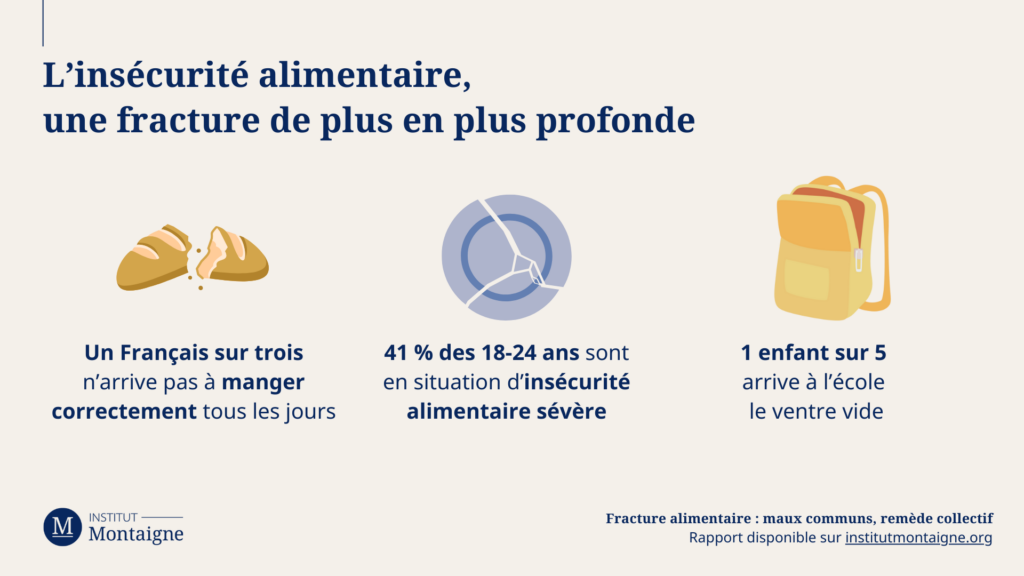
- In France in 2023, more than one in three French people (37%) will find themselves in a situation of food insecurity - defined as those who are unable to feed themselves properly every day. This proportion rises to 41% among young people aged 18 to 24.
- 1 in 5 children arrive at school hungry
- The number of food aid recipients rose significantly in 2023, reaching 4 million declared beneficiaries.
- 75% of food aid recipients live in households where the standard of living is less than 40% of the median income.
- 21,000 communes in France, i.e. 62% of communes (mainly in rural areas), have no food retail outlets.
Dietary imbalances in France
The problem of unbalanced nutrition is also alarming in France.
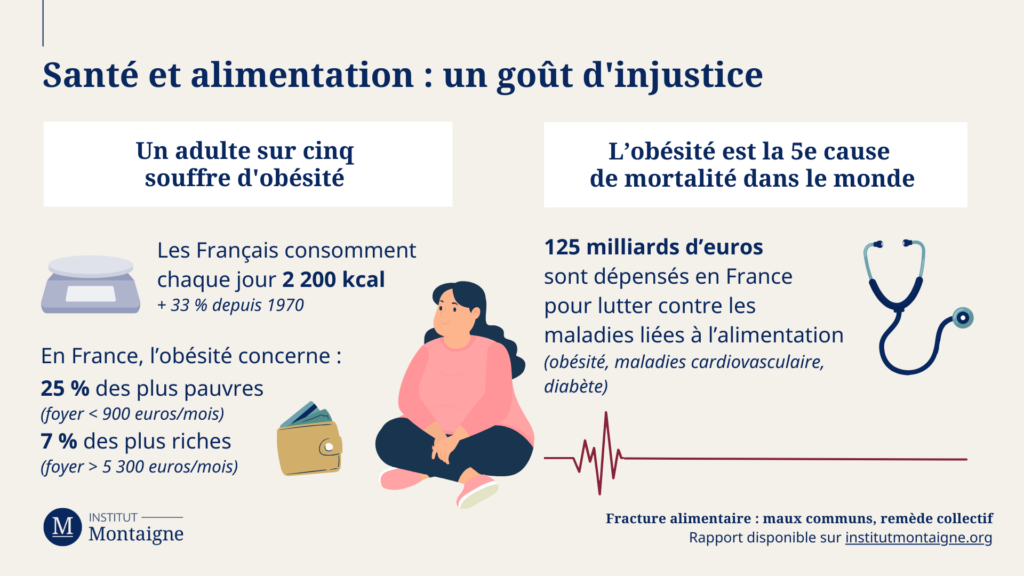
- Nearly 50% of adults in France today are overweight, a figure that is constantly rising.
- Les aliments ultra-transformés représentent environ 30 % de l’apport énergétique des Français. En comparaison, les niveaux vont jusqu’à 40 % en Allemagne et 50 % aux États-Unis.
- 87% of children and 47% of adults consume more sugar than recommended by the WHO. An 8-year-old child has already consumed more sugar than his grandfather did his whole life.
- En 30 ans, le taux d’obésité a doublé chez les adultes. De plus, il a été multiplié par 4 chez les 18-24 ans.
- Only 1 child in 5 (20.2%) meets the PNNS target of eating 5 fruits and vegetables a day.
The 6 key recommendations of the Food Fracture report
Based on a collegial analysis carried out through over a hundred hearings and a working group mobilized over an 18-month period, the report formulates 6 major, quantified and tested recommendations.
It puts forward concrete, applicable solutions aimed at reducing food insecurity and guiding our society towards a healthier diet accessible to all, based on socio-economic, cultural and geographical levers.
- Supporting local players on the front line of the social crisis
- Providing budgetary support to French people in food insecurity to help them buy fruit and vegetables
- Sustaining the spread of quality catering on a national scale
- Reducing sugar intake in children and adolescents
- Tapping into the imagination around the pleasure of a balanced diet
- Encourage consumption of fruit and vegetables by creating an optional, targeted supplement to employee meal vouchers.

Procurement responsible: how to take biodiversity into account?
Directorates Procurement, increasingly aware of biodiversity issues, are actively integrating these principles into theirProcurement responsible strategy. Find out how Procurement, at the heart

CSR labels: how can iQo help you?
Obtaining a CSR label can be a daunting task for companies who set out without a methodology. A specific CSR label attests to a company's or an organization's

iQo becomes a member of Institut Montaigne
The Institut Montaigne is a think tank renowned in France for its apolitical stance, open to the intersection of three fields. In this article and on video, we describe the