9 trillion euros will be transferred in France by 2040, marking the largest wealth transfer in history. This represents a historic opportunity for retail banks—provided they reinvent their private banking model.
The challenge is clear: How can we attract a new generation of customers—one that is more digitally savvy, more demanding, and less loyal to traditional models?

Contents
1. The Largest Wealth Transfer in History Is Expected to Take Place in France Between 2024 and 2040
The Private Banking market offers considerable potential for value creation, with the eligible client base continuing to grow.
Demographic and economic trends point to the largest transfer of wealth in history between 2024 and 2040, with nearly 9,000 billion euros in assets being transferred, primarily from the oldest French citizens to their heirs. This transition represents a unique opportunity for private banks to attract a new generation of clients.
At the same time, more than 500,000 businesses will be up for sale by 2035, heightening the challenges of retaining and attracting business owners at this critical juncture—a time when wealth management support is particularly valuable.
This context of transformation is part of a rapidly changing banking landscape.
2. New players are emerging and capturing value in certain segments and areas of the market
Online Banks
Online banks (e.g., BoursoBank, Fortuneo) are shaking up the private banking industry by targeting the mid-tier wealth management segment, typically for clients with assets ranging from 100 to 150 k€. These providers now offer discretionary investment management, personalized wealth management guidance, and even private equity investment solutions, all at very competitive rates.
Their promise: a seamless digital experience, lower fees, and an initial level of advisory service. Traditional private banking, on the other hand, has historically focused on higher entry thresholds.
Digital platforms
At the same time, digital platforms and wealthtech companies (such as Yomoni, Finary, Nalo, and Moonfare) are redefining the rules of wealth management. They offer innovative services such as wealth aggregation, robo-advisory, automated financial planning, and easier access to alternative investments (private equity, fractional real estate, art, etc.).
Real Estate Investment and Tax Planning Advisors
Finally, real estate and tax planning advisors are also becoming increasingly proactive and expanding their scope of services by incorporating financial allocation advisory services into their offerings, which have historically focused on real estate investment.
While these new players do not directly compete with traditional players in the ultra-high-end segment, they are contributing to the fragmentation of customer behavior and the trend toward using multiple banks, forcing established players to rethink their positioning and value proposition.
Laura PERRES-GANNÉ, Partner, Banking
3. New strategic segments that generate value for banks
Historically, the private banking market was divided into four segments based on the level of financial assets:
Historical Segments
Key Features
Financial assets of up to €500,000
In addition to this traditional approach, there are new value-driven segments:
NextGen
Heirs or young adults from wealthy families. Often entrepreneurs themselves, they are exposed to the challenges of wealth management at an early age.
They are looking for agile and innovative support that aligns with their values—particularly in terms of impact, technology, and the meaning they ascribe to their wealth. They can be engaged very early on through the concept of family private banking.
New Silver
Seniors, a rapidly growing demographic group, generally possess significant wealth accumulated over time.
They seek secure and stress-free wealth management that focuses on quality of life and planning for the transfer of assets
Women Entrepreneurs / High-Net-Worth Women
Seeking meaning in their investments and long-term guidance, particularly on issues related to impact, succession, and governance
Mobile customers, without borders
Increasing mobility among ultra-high-net-worth clients (expatriation, business assignments).
They are seeking cross-border expertise to manage complex estates, balancing mobility, taxation, and international organization
Family offices
High-net-worth families (>20–30 M€), often already organized into sophisticated wealth management structures.
They are looking for trusted partners capable of offering tailored solutions in governance, succession planning, and impact investing, with a long-term perspective.
These new segments hold significant value potential for banks; they must be identified within existing portfolios and prospecting targets so that banks can offer them tailored and differentiated approaches.
A Transformation Path Banks Must Embark Upon to Accelerate Their Private Banking Operations
Banks must undertake a profound transformation of their private banking model to strengthen their position in the face of increasingly diverse competition and within a complex and evolving regulatory environment.
An analytical framework to be developed to provide a comprehensive understanding of the development challenges facing Private Banking:
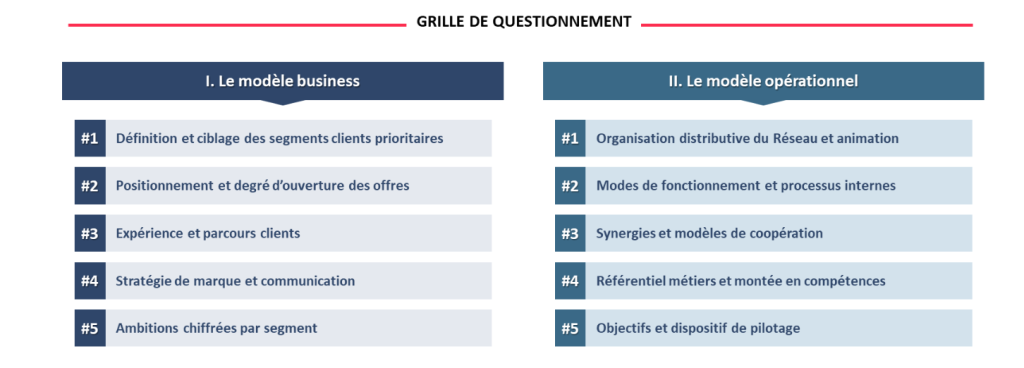
This questionnaire helps formalize a maturity assessment and identify the building blocks that need to be activated to initiate priority transformations.
5. Transformation Challenges to Win the Battle
Banks have strong advantages that enable them to become trusted partners to high-net-worth clients and executives by offering a comprehensive and integrated approach to private banking.
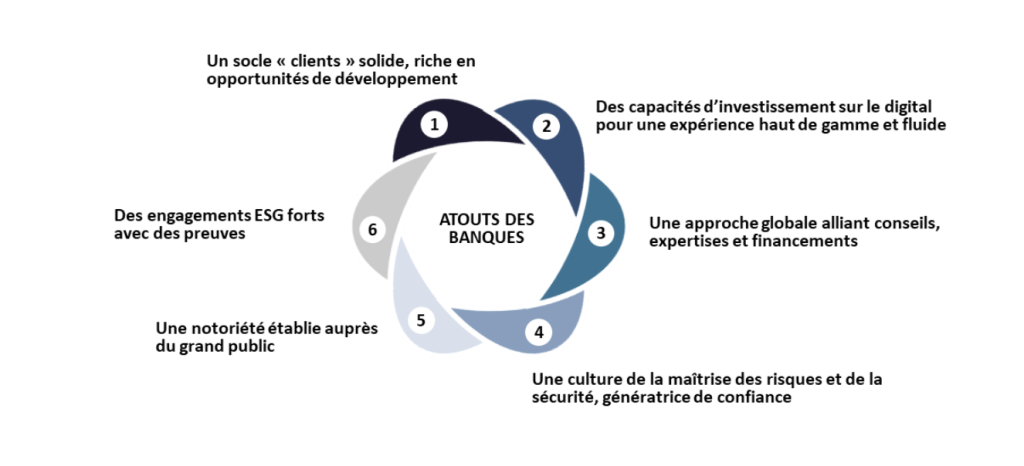
To make the most of these strengths and win the battle, here are 6 challenges to tackle:
- Harnessing the power of data to identify and uncover future Private Banking clients within existing portfolios
- Attracting, training, and equipping “hunter” private bankers: Prospecting at the heart of the strategy and objectives
- Move beyond the stereotype of “thick carpet” by modernizing the customer experience through the digitization of interactions and the specialization of processes to enhance responsiveness
- Turning Some Competitors into Partners: Building an Open Ecosystem to Enhance the Value Proposition and Expand the Range of Offerings for Customers
- Make ESG one of the pillars of our offering, in line with customers’ new expectations
- To clearly and emphatically highlight our expertise as a general-purpose bank capable of providing a comprehensive, distinctive private banking service that is deeply rooted in local communities

Banks
Learn about our expertise and experience in addressing the challenges facing the banking sector.

What social strategy for banks and insurance companies?
Developing and implementing a social strategy is a key challenge and an asset for banks and insurance companies. It is even becoming a necessity in a macroeconomic, demographic, and social environment

Which CSR labels should banks and insurance companies choose?
A specific CSR label certifies that a company or product complies with a specific standard. But how can mutuals, banks and insurance companies do this?

How to optimize the efficiency of a retail bank's support functions?
The efficiency of support functions is a key challenge for retail banks, reinforced by the current economic climate. Indeed, sustained inflation and rising interest rates are forcing
FAQ – Reinventing the Private Banking Model
Why is this referred to as the “largest transfer of wealth in history”?
The world is about to experience a massive transfer of wealth between generations, primarily from baby boomers to their heirs.
In the United States, nearly 90,000 billion dollars in assets are expected to be transferred over the next few decades. Globally, estimates put the total at more than 80,000 billion dollars by 2048.
This phenomenon is reshaping the wealth management market: banks must attract and retain a new generation of heirs, who are often younger, more digitally savvy, and more likely to switch financial institutions than their parents.
Why Do Retail Banks Need to Rethink Their Private Banking Model?
Historically, private banking was based on a personal relationship with an advisor and a standardized wealth management offering. However, this model is reaching its limits in the face of new expectations from high-net-worth clients.
Banks must now:
- provide a seamless digital and omnichannel experience;
- provide broader access to distinctive asset classes (private equity, alternative investments);
- Integrate high-value-added services: wealth management, tax advisory, and intergenerational support.
Without this change, a significant number of heirs might switch asset managers after the estate is transferred.
How can a retail bank capitalize on opportunities arising from the intergenerational transfer of wealth?
To capitalize on this historic cycle, retail banks must transform their approach to wealth management:
- Segment the high-net-worth client base more preciselyto identify high-potential clients.
- Create hybrid offerings that combine retail banking and private banking.
- Engage the “next generation” today (heirs, entrepreneurs, young investors).
- Strengthen data and analytics to anticipate wealth-related events and personalize support.
The challenge is to shift from a product-based approach to one focused on building long-term relationships across multiple generations.