Choosing among several offers, balancing independence with support, selecting a contact channel, deciding on the form of compensation: throughout the customer relationship, the customer expresses preferences. Yet many customer journeys are still designed as one-way paths, optimized primarily for business processes. Available studies show that beyond the quality of the solution itself, satisfaction also depends on the feeling of being in control. When well-orchestrated, choice thus becomes a true driver ofcustomer experience.

Summary
Choice is at the heart of the customer journey and the customer experience: choosing a plan, deciding whether to proceed on your own or with an advisor, selecting a solution after a problem arises, and deciding whether to stay or leave. Studies show that customers are more satisfied when they remain in control at every step, and that imposing a single way of doing things damages the company’s image. It’s not about offering more options: two are enough, as long as the customer is never left with none at all.Contents
1. What the studies show: Choice as a driver of satisfaction and perceived control
A sense of control enhances the experience
As early as 1991, Hui and Bateson (Journal of Consumer Research) showed that customers who feel in control of the situation have a more positive experience and are less likely to leave.
The issue isn't "too many choices," but the complexity of the decision
By analyzing 50 experiments, Scheibehenne and his colleagues (2010) show that, on average, offering more options does not discourage customers. The effect becomes negative especially when the offering is complex, the decision is difficult, or the customer’s preferences are not yet well established (Chernev et al., 2015).
Conversely, the lack of choice is clearly a disadvantage
This is the main finding of the study by Reinders, Dabholkar, and Frambach (Journal of Service Research, 2008), which we detail below: when a single channel is mandated, satisfaction, recommendation, and retention intentions decline.
2. Focus: A Study of the Dutch Railways
The starting point: What happens when self-care becomes mandatory?
In the mid-2000s, automated machines became widespread: self-checkout registers, airport check-in kiosks, and ATMs. In the Netherlands, some small train stations no longer have ticket windows.
Three researchers—Machiel Reinders and Ruud Frambach (Vrije Universiteit Amsterdam) and Pratibha Dabholkar (University of Tennessee)—then pose a question that has become central to the design of customer journeys: What happens when the customer no longer has a choice of service mode?
The Method: Two Approaches, Three Service Models
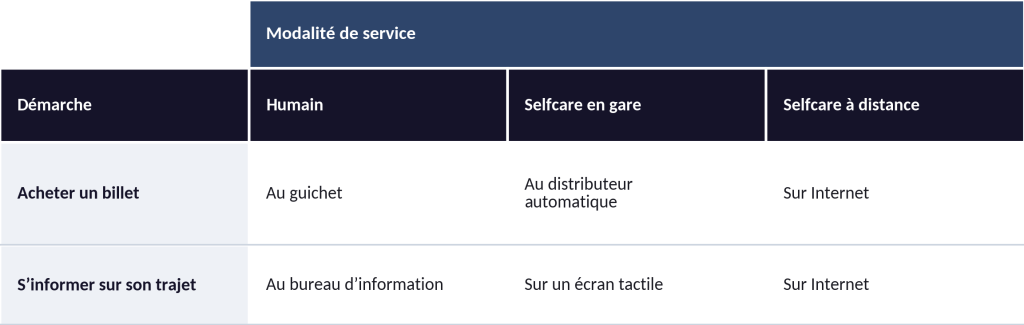
- No choice: only one option is available to the customer.
- Limited choice: Two out of three options are available.
- Full range of options: all three options are available.
Results of the Study on Choice in Customer Journeys
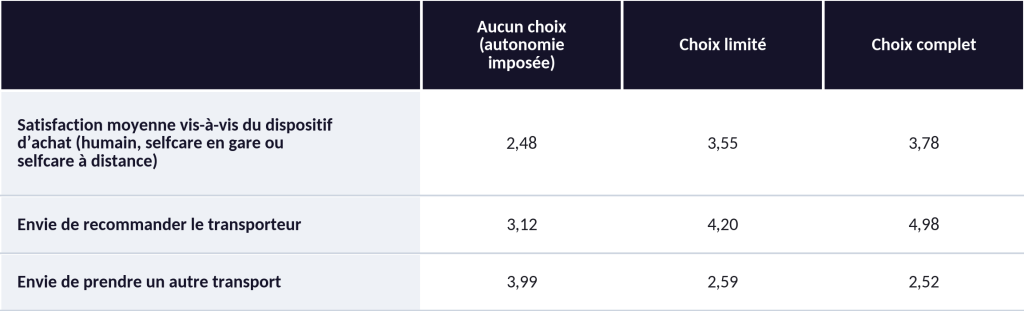
- Imposing a single method degrades the experience and the relationship with the brand. Customers judge the purchasing process more harshly, are less likely to recommend the brand, and are more likely to consider an alternative.
- The first level of choice creates the bulk of the value. The benefit is very pronounced between “no choice” and “limited choice,” and then much smaller between two and three options. Even a choice between two self-care options is preferable to a single, imposed option.
3. Choice as the common thread throughout the customer journey
Before the purchase: Make the decision easier, without limiting options
At the point of sale, offering choices does not mean exposing the customer to the entire product line. The challenge is to create a clear choice architecture that reduces the effort involved in decision-making without taking away the customer’s ability to weigh options. A CEB study published in the Harvard Business Review (2012) shows that brands that make the purchasing decision easiest are purchased 86% more often and recommended 115% more often.
During the relationship: balancing autonomy and support
Signing up, modifying a contract, filing a claim, tracking an order: the right customer journey doesn’t pit digital against human interaction. It allows customers to choose their level of self-service and switch to speaking with an advisor when the situation calls for it.
The Dutch study shows that a mandatory damages the company’s image, whereas the ability to reach a live agent largely offsets this. And to increase the use of self-service, incentives seem more effective than mandates: when an agent recommends it, twice as many customers say they are willing to use it during their next interaction (Gartner, 2025).
Illustration: AI, chatbot, or advisor—who’s in control?
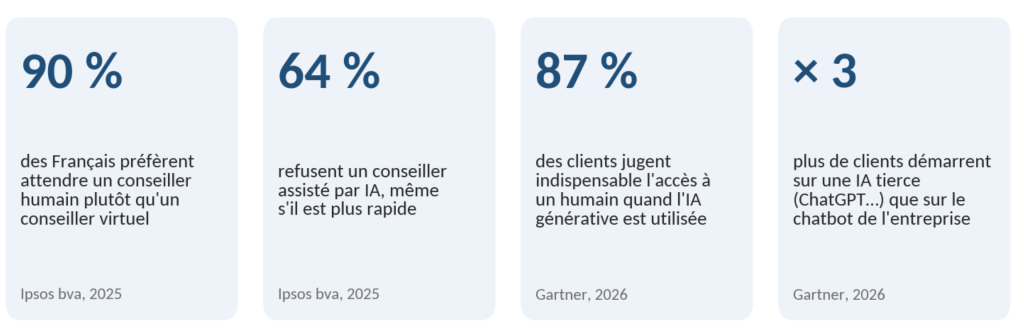
The Rise of AI brings the same question to the forefront as it did in 2008: Who decides how service is delivered? French customers accept automated tools, but expect to retain the option of human interaction and not be locked into a single channel.
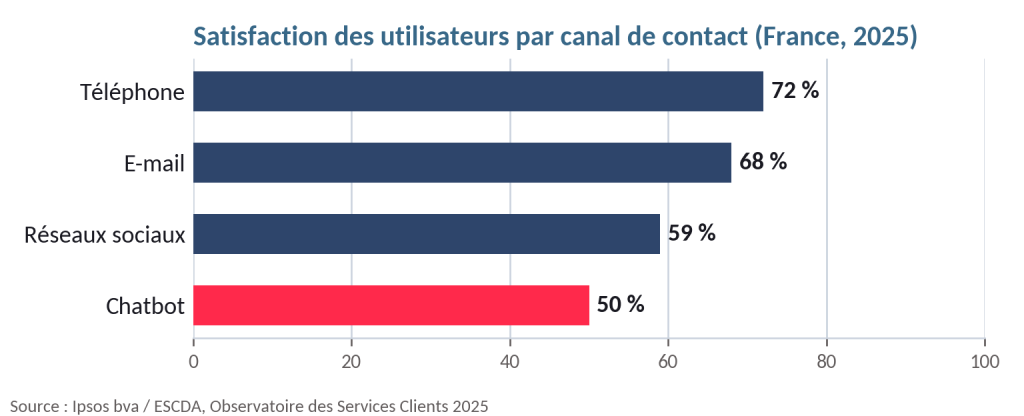
The chatbot is becoming more widely used, but remains the channel that generates the lowest satisfaction levels. The tool’s performance likely doesn’t explain everything: in many customer journeys, it serves as an imposed entry point rather than an explicit choice made by the customer.
The challenge, therefore, is not to pit AI against human advisors, but to orchestrate their complementary rolesby giving the customer two key choices: their point of entry, and the option to switch to a human advisor at any time. A recent study (Humanities and Social Sciences Communications, 2026) shows that the transfer experience differs depending on whether it is requested by the customer or initiated by the system. When the customer chooses to switch to a human advisor, the advisor’s attentiveness and empathy become crucial.
When a problem arises: Restoring Control Through Choice
It is during moments of friction that choice becomes most valuable. Chang (2008) shows that after an incident, offering several solutions and letting the customer decide improves their satisfaction—both with the chosen solution and with the overall experience. The effect is all the more pronounced when the stakes are high for the customer. The same logic applies to compensation: a gift, a refund, or a complimentary service do not hold the same value for all customers. Offering a choice helps restore a sense of control precisely at the moment when the incident has undermined it.
4. What about profitability? Is a prescribed route really more profitable?
Choice and profitability are not mutually exclusive. A well-designed self-service solution remains a powerful driver of efficiency when it meets the customer’s needs and effectively resolves their issue. In fact, twice as many customers are willing to use self-service again when an agent recommends it to them (Gartner, 2025). The option to speak with a representative also serves as a source of reassurance, even when it isn’t ultimately used.
The challenge for a marketing and customer experience team is therefore less about maximizing the self-service rate than about optimizing the overall efficiency of the customer journey: promoting self-service where it is simple, effective, and adds value, while maintaining seamless access to an agent for complex requests, moments of vulnerability, high-stakes incidents, or situations where digital solutions reach their limits.
5. Five Principles for Marketing and Customer Experience Departments
-
Map out the moments when choice creates value.
For each step, identify who currently makes the call: the customer, the advisor, or the process. Prioritize high-stakes or high-friction moments, where an imposed decision is most likely to negatively impact the experience. -
Design a simple, guided decision-making process.
Two or three relevant options are usually sufficient. The main benefit comes from moving from no choice to a choice; beyond that, adding more options can actually increase the effort required to make a decision, especially when the offering is complex. - Ensure uninterrupted access to human support throughout the customer journey. While self-service may be the preferred option, it must not become a dead end. The option to speak with an advisor provides reassurance, even when it isn’t used. It must therefore be designed as an integral part of the customer journey—and factored into staffing levels.
- Give advisors structured autonomy. In the event of an incident, it is better to provide them with a range of pre-approved solutions and compensation options so that they can work with the customer to develop the most appropriate response, rather than applying a one-size-fits-all solution.
- Measure perceived control, along with satisfaction and effort. Include a simple question in surveys—“I was able to choose how I was served”—and then test different customer journey variations under real-world conditions. The goal: to measure the effect of choice on satisfaction, loyalty, and costs, beyond stated intentions.
When well-designed, choice is neither a luxury nor a source of added complexity. It is a design principle for the customer journey that meets customer expectations and is increasingly in line with regulatory requirements. The challenge is not to increase the number of options, but to preserve room for decision-making where it matters most.
Julien BAILLIEUL, Partner at iQo
Conclusion: Tailor the choice rather than standardize the path
Automating, simplifying, and controlling costs does not mean standardizing the experience. The challenge for marketing and customer experience teams is to design a coherent framework of choices throughout the entire customer journey: few options, clearly differentiated, presented at the right time, with a recourse option when the situation calls for it.
At iQo, we work with our clients to identify these pivotal moments, translate them into customer journey and organizational principles, and then measure their impact on the customer experience and performance.

Customer Journey Consulting
Learn about our approach and our services to help marketing departments optimize their omnichannel customer journey.
Frequently Asked Questions: Customer Journey
Why does giving customers a choice improve their experience?
Should an optimized customer journey offer a wide range of options?
At what points along the journey does the choice matter most?
How does iQo help companies optimize their customer journeys?
iQo helps companies map customer journeys, identify pain points, design target experiences, and define prioritized roadmaps. By combining strategy, design, data, and operational transformation, our expert teams in Customer Journey help turn insights into concrete, measurable actions.

Remote Customer Service: Building a Truly Effective Operational Model
Companies must structure their customer relationship management in a way that is consistent with their strategy, business objectives, and quality requirements. Defining a target operational model allows for

How to measure customer satisfaction: what systems need to be put in place?
To measure customer satisfaction, it would be a mistake to stop at a few well-known indicators (NPS, CES...). In fact, to look beyond these indicators is to ask the question: "How do we measure customer satisfaction?

Clienteling: definition, relevance and challenges in an omnichannel strategy
The term "clienteling" most often refers to a highly personalized approach to the relationship that develops between a customer and a sales associate in a store, with the goal of building customer loyalty.