
Author: Jean-Baptiste Waldner
Next book to be published: White Collar Robots and Enterprise 4.0 Management
From ownership to on-demand consumption?
The notion of ownership, of financial assets, has long reassured entrepreneurs and shareholders alike. Owning one's information system, one's own technological infrastructure and software, being able to amortize them and use them without constraint throughout their lifecycle like any production equipment, building or other investment, is a source of serenity, a certain symbol of success or accomplishment.
Proof of this is the natural propensity to buy one's own home, even when the economic balance sheet argues in favor of renting. Choosing freely to evolve with technological progress, the way to use tools and to change them, seems more obvious when you actually own them.
Until the early 2010s, the dematerialization of business processes was based on a collaborative infrastructure that did away with the physical location of people and equipment, replacing traditional document carriers with electronic exchanges. The technical means of this dematerialization, the digital tools and equipment - with the exception of the web network infrastructure - remained, for the most part, the exclusive property of companies.
The arrival of the big Internet players - Google, Yahoo, Facebook, Amazon - has suggested a new way of using digital services, without the need for specific hardware or application software. All you need is your computer's web browser (or, later, your smartphone). This approach immediately appealed to the general public: availability is immediate, and intuitive use is very simple. From a free service for consumers financed by online advertisers, the model was quickly applied to the consumption of services billed on a pay-per-use basis. We no longer buy our music on CD or DVD, or our newspapers in paper format, but consume online in the form of downloads or subscriptions.
The same concept has been imagined for the enterprise: an online service, with no need for special equipment or prior installation, ease of use and billing exclusively on a per-use basis ("On-Demand").
The means to produce, maintain and improve this service are transferred to the service provider. No need to anticipate changes in the company's business and plan risky investments to cope with them. In principle, you only pay for what you use.
Power, flexibility and simplicity
Cloud Computing means storing and accessing data, programs, applications and files on the Internet, rather than on a company's own infrastructure or on a dedicated outsourced platform.
Cloud computing provides a flexible, scalable on-demand service, accessible online via the communications network and billed as a "service consumption" according to the actual use of resources. These online services, beyond data storage and access, can include all kinds of applications, in-house solution development resources or even dedicated computing centers, accessible via the Internet from anywhere in the world.
Cloud Computing differs from previous remote and outsourced service offerings in its universal access and contractual flexibility.
The notion of self-service means that, once the framework contract has been validated, any upgrade or capacity modulation is possible (within a predefined bandwidth) without contractual notice or technical delay, as long as solvency is guaranteed. As services are accessible via the Internet, access to new workstations is immediate and straightforward. But the main advantage of infrastructure cloud computing lies in the pooling of resources. Applications require peak computing power, which can often prove prohibitive for in-house hosting, and which, given the average level of power required, does not justify such a profusion of idle resources. The massive data processing that characterizes new enterprise applications is the ultimate argument for this new form of consumption.
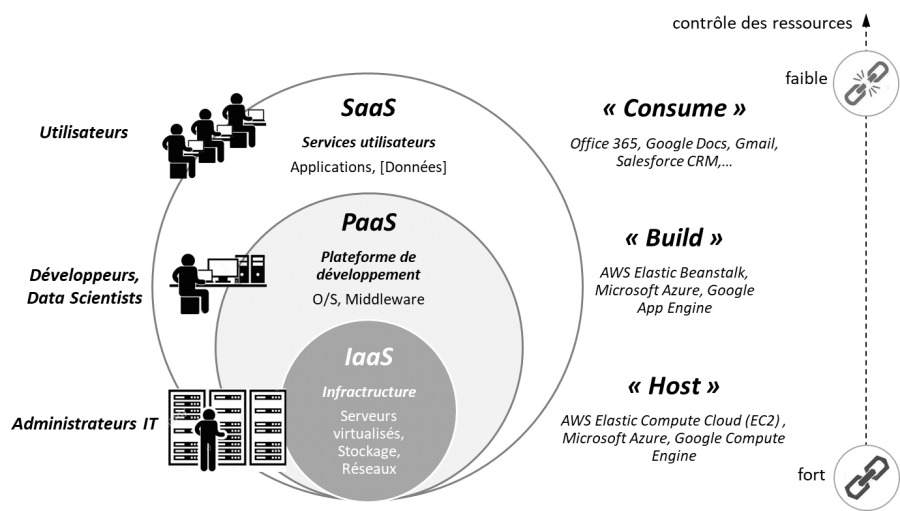
An option for the digital transformation of the 2020s
The concept is attractive in theory. The record of its implementation is a little more mixed. After a perplexing observation phase, the main fear being security, a few pioneers embarked on the adventure in 2008, abandoning their expensive hardware assets in their ivory towers, or rather air-conditioned bunkers, in favor of this new digital nomadism. In the early 2010s, this new way of marketing became a priority for all software publishers. "Selling fish rather than fishing rods" should stimulate more regular consumption of new services. In terms of infrastructure, incumbent hardware operators (Microsoft, IBM, HPE, Dell, Cisco, etc.) and new infrastructure players (Amazon) are placing IaaS at the heart of their commercial offering. Indeed, it is this segment of Cloud Computing that has shown the strongest appeal to businesses over the decade. In 2017, the figures show that the trend has begun: one in four companies has decided to host its infrastructure (servers, storage and networks) in the Cloud.
Success has been more muted when it comes toSoftware as a Service (SaaS) applications. Integrating a SaaS solution into a company's overall ecosystem presents the same constraints and difficulties of interdependence with other applications as implementing " on-premise " solutions, with the added constraints of updates and upgrades imposed by the publisher. On the other hand, the SaaS mode is a real boon for many small structures (e-commerce, logistics, etc.) that would not be able to access this type of application through an internal integration mode, as the entry ticket would be incompatible with their income. This is also the mode of choice for all collaborative working and unified communications tools (instant messaging, application and document sharing, collaborative office automation, videoconferencing, telephony), as well as for CRM and Business Analytics applications now integrating Big Data.
At the dawn of the 2020s, the bottle is half empty and half full. The picture is probably less optimistic than the many publications from solution providers, but behaviors are changing, and the next decade, with the advent of massive data, can only give credence to this new way of operating. Until now, cloud computing has been a somewhat avant-garde option. This technological alternative can no longer be ignored in the studies and digital transformation projects of the 2020s.
Also read about data

Data For Good
If we had to give a simple definition of Data For Good, it's the contribution of data science as a lever of innovation for good for society.