

Drawing up a marketing plan: method and best practices

Drawing up a marketing plan is an essential ritual for all marketing managers. It sets the course, priorities and resources required for the coming year, and provides a 2/3-year outlook.

Building a marketing plan requires a rigorous methodology and advance planning to meet deadlines. Find out more about the method and best practices for developing your marketing plan.

marketing plan

Contents

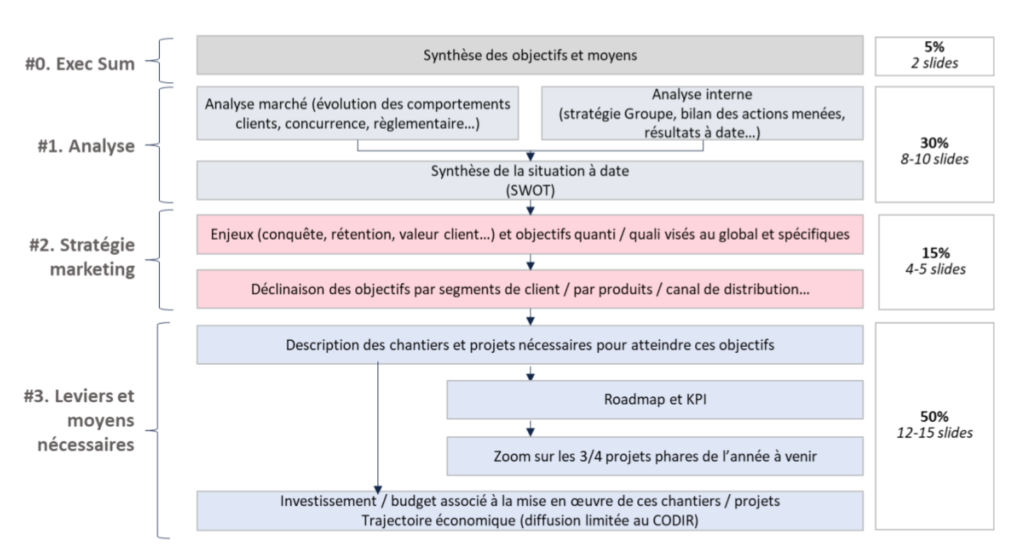
The marketing plan consists of 3 main parts

Before thinking about means and actions, a marketing plan must follow a clear method. It is composed of 3 main parts.

marketing plan

1. Analysis: the first step in defining a marketing plan

Market analysis

It provides in-depth knowledge of the market and its potential, the company's positioning in the market and that of its competitors, and the expectations of customers and prospects, as well as any changes in these expectations.

Market analysis must be exhaustive, including information on competition, market trends, new regulations, changes in customer behavior, socio-cultural, technological and environmental contexts, and so on.

PESTEL analysis (Political, Economic, Social, Technological, Environmental and Legal context analysis) provides a comprehensive view of the market environment.

A word of caution: analyses of each market segment should not be redone in their entirety every year: they should be carried out by capitalizing on the analyses of previous years and enriching them with the latest developments. The frequency with which they are repeated in their entirety must be defined pragmatically, in particular according to new regulations, potential new entrants to the sector...

Internal analysis

It enables us to get to know our customers better (portfolio analysis), analyze the performance of existing offers and associated distribution channels, and identify areas for differentiation. The analysis includes :

Analysis summary

The SWOT results from the consolidation/synthesis of market and internal analyses. It is an important element for structuring ideas and quickly relaying information, as well as for asking PM readers for a synthetic vision of the strengths and areas for improvement to be prioritized. The SWOT must also be understandable to the uninitiated.

2. Description of marketing strategy

The marketing strategy defines the major challenges for the period ahead, based on an analysis of the company's context and strategy (conquest, loyalty, brand awareness, digital, etc.).

These challenges are then broken down into quantitative and qualitative objectives (win x new customers, reduce churn by x%, etc.). These objectives must be relevant in order to monitor the success of the marketing plan. They can be broken down by customer segment, product segment, distribution channel... depending on the angle from which the marketing plan is viewed.

3. Marketing levers and resources to meet this strategy

Several KPIs enable you to evaluate the success of your marketing campaigns. Coverage, click-through and repeat rates give an overview of the exposure to the product/service via a given campaign. ROMI, on the other hand, focuses on return on investment.

Define actions within your marketing plan

It is then necessary to define precisely the actions to be taken over the course of the year to achieve the marketing strategy.

For each challenge defined in Part 2, the actions to be taken, grouped by project, are detailed. These projects/actions are also presented in the form of a roadmap, which identifies the key milestones for the year, and the main contributors to be mobilized.

You can also zoom in on the year's top 3 or 4 projects.

Finally, the budget required to carry out all these projects is presented.

A marketing plan must be a clear demonstration of

The important thing is to be pedagogical, to explain ideas and recommendations clearly and succinctly, to guide the reader through the reasoning to its conclusion. Clarity is key, since the marketing plan must be understood by all its readers, including those who were not involved in its development.

It's also a good idea to include summary sheets for sales staff, if this is relevant to your company's context. These sheets help to ensure a common discourse and objectives throughout the company.

4. Manage your marketing plan over time

In addition to building a marketing plan, monitoring it is also key. A good practice is to schedule a marketing plan follow-up meeting every 2/3 months in order to :

This monitoring is factualized through a few key indicators :

How can iQo support your marketing and customer experience strategy?

iQo works with you to build an optimal optimal customer strategy and effective marketing plans. We have particular expertise in defining marketing, development and loyalty plans, and in framing customer service transformation programs. customer service transformation and customer ambition, as well as optimizing marketing campaigns and customer journeys.

We have a dedicated training program to help teams design and implement their marketing plan.

iQo: consulting to accelerate transformations

iQo is a new player in the consulting sector, whose mission is to "unleash collective genius to co-construct desirable futures". Our firm offers a unique approach to co-construction with our customers ...

Nous sommes une société à mission et avons co-construit 23 engagements à impact positif avec nos collaborateurs.

If you'd like to find out more, or get practical feedback on this topic, please contact us!

Marketing & Customer Experience

Discover our expertise to help your company meet these challenges
julien baillieul associate consulting firm

Julien BAILLIEUL

iQo Partner
LinkedIn

beatrice torre associate consulting firm

Béatrice TORRE

iQo Associate
her LinkedIn profile