

To ask the question of customer experience strategy is to recognize that taking account of the customer experience has gradually spread throughout BtoC and BtoB companies. For example, dedicated customer experience functions are not uncommon in MarketingDigital or Customer Relations.
At iQo, we've observed that there's one difficulty we still face every day when it comes to giving meaning, fully involving teams and managing all the associated projects: how do you define and formalize your customer experience strategy?
Contents
The importance of the customer experience in 4 figures
There are many commonly shared tools for defining a corporate strategy or business model.
However, there is no reference framework for defining a customer experience strategy, putting it into practice and sharing it easily internally. Indeed, the concept of customer experience is still relatively abstract...
What is customer experience?
The customer experience is generally defined as all the emotions felt by the customer in relation to the company - before, during and after a possible purchase (source: Welcome to the Experience EconomyB. Joseph Pine II and James H. Gilmore, Harvard Business Review (July-August 1998)).
To provide a more concrete framework for its definition, we could define customer experience as "What I would like my customers to say about me".
How do you define your customer experience strategy?
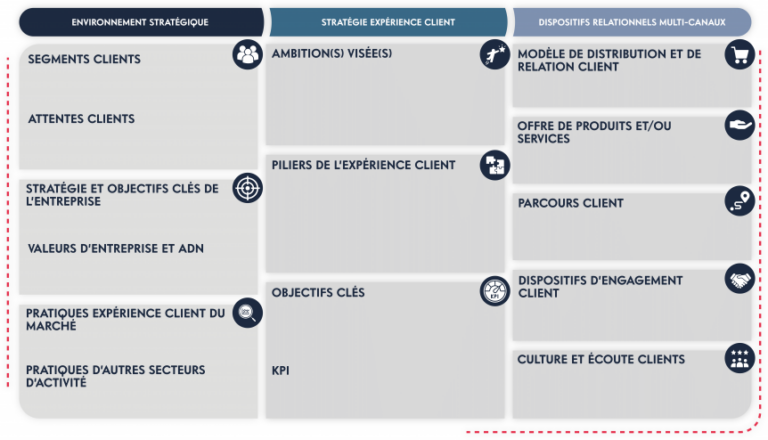
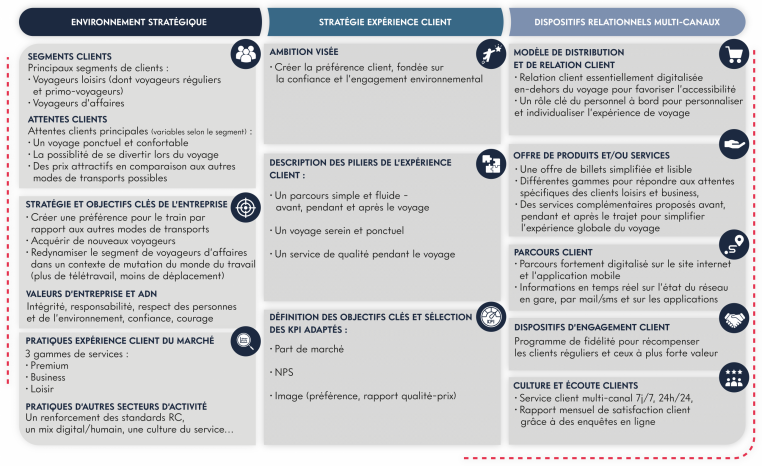
To facilitate the definition of a customer experience strategy, we have defined a reference framework that is easy to use and adaptable to all environments: the CX ID by iQo.
iQo's CX ID methodology enables :
- Describe the strategic environment: customers, strategy, external and competitive environment;
- In response, describe the customer experience strategy: an ambition, pillars answering the question "what would I like my customers to say about me" and objectives;
- Describe the relational systems that will support this strategy in concrete terms: the distribution model, the offer, the customer paths, the customer engagement and culture systems.
Defining the company's strategic environment
The first step in the CX ID process is to map out the company's strategic environment. This involves answering the following questions:
Customer vision
- What are the main customer and prospect segments?
- What are the priority segments in terms of acquisition/loyalty?
- Which are the most valuable
- What are their expectations/needs?
The corporate vision
- What is the company's strategy?
- What are its key objectives?
- What are the company's values and DNA?
Market vision
- What are the competitors' positions/practices?
- What are the multi-sector best practices applicable to the company's environment?
Defining the customer experience strategy
The ambition
The next step is to formalize the company's ambition in terms of customer experience, in line with its strategic environment. Ambition gives meaning to the company's medium-term vision. The ambition of a customer experience strategy can be expressed in different ways:
- Quantitative or market positioning ambition
Ex: "Be the leader in...", "Satisfy 100% of our customers...". - Ambition to recognize experience in a specific dimension
Ex: "Offer a digital experience...". - Customer impact ambition
Ex: "Simplify customers' daily lives...".
The pillars of customer experience
Based on this ambition, the next step is to define the pillars of the company's customer experience: "What do we want customers to say about us? A good practice is to identify 3 or 4 pillars at most, which embody the ambition.
For example:
- Reliable (the company is always sincere and loyal)
- Close (the company knows me, my relationship with it is unique)
- Stimulating (the company opens me up to new ideas and inspires me)
- Listening (the company really listens to me)
At this stage, the aim is to make choices and identify the key priorities for the company's development, based on the 3 visions described in the strategic environment. It is therefore necessary to identify fundamental pillars, as well as pillars that will enable the company to differentiate itself from other market players.
The definition of these pillars requires several iterations to ensure that they respond to the strategic environment.
KPI's
Finally, appropriate KPIs (Key Performance Indicators) are identified to assess the achievement of the ambition and the response to the chosen pillars.
Translating customer experience strategy into multi-channel relational systems
For the customer experience strategy is sufficiently robust and concrete, the next step is to apply these pillars to all the devices that make up a company's customer experience.
Examples include :
- Its distribution model and customer relations
- Its product and/or service offering
- Its customer paths
- Its customer loyalty and engagement systems
- Its customer culture and its listening to the voice of the customer
How do you define a customer experience strategy based on CX ID?
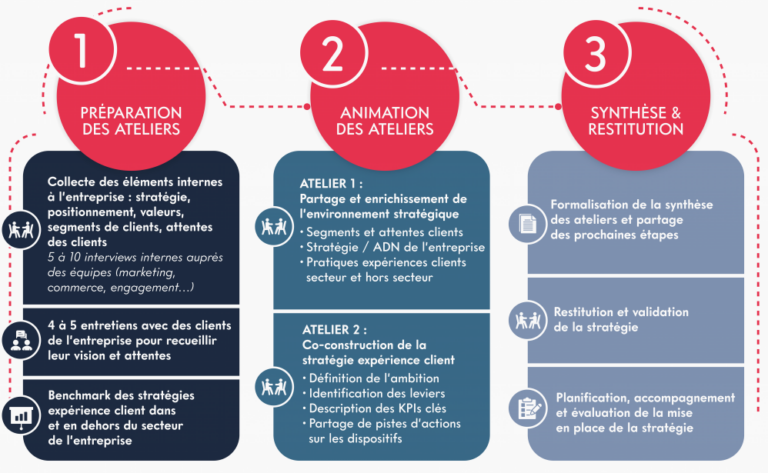
We have developed a collaborative approach to defining a company's customer experience strategy in 3 stages:
- An initial phase of internal and external data collection. Internal elements (strategy, positioning, values, customer segments, customer expectations, etc.) are collected through internal interviews with marketing, sales and commitment teams. Customer interviews and benchmarks from other players feed this first phase with external elements.
- A second phase, consisting of workshops involving the company's teams, enables the framework defined in phase 1 to be shared and enriched, and the customer experience strategy to be co-constructed: specifying the company's ambition in terms of strategic pillars, breaking it down into key indicators, and defining courses of action for implementing this strategy in the company's relational system.
- The third phase is used to summarize and report on all the work carried out, and to validate the strategy and its implementation in operational and relational terms.

3 steps to measuring Customer Experience ROI
The customer experience, like other aspects of marketing and customer relations, needs to be measured to assess ROI. Our experts give you the 3 steps to

The customer experience: the new central issue in delegated insurance management
In an ever-changing insurance industry, where operational efficiency, flexibility and cost control remain the watchwords, delegated management is a key pillar of our strategy.

How do you define a Customer Experience framework?
Vous connaissez (sans doute) le référentiel produit ainsi que le référentiel de relation client, mais connaissez-vous le référentiel expérience client ? Pourtant, le référentiel de l’expérience client est aujourd’hui fondamental