

Cloud migration for CIOs: benefits and limitations

Migration to cloud hosting solutions solutions (AWS, Azure, Google, ...) has become one of the levers of digital digital transformation. Chief Information Officers (CIOs) play the leading role in this transition, guiding their organizations through this major technological change. To succeed in this transformation, they need to be clear about the benefits achievable and the real limits of the model.

cloud dsi migration

In every sector of activity, significant players have achieved this "Move to Cloud". "Move to Cloud with varying degrees of success. It's important to note, however, that none of these players has completely reversed course. With the benefit of a few years' hindsight, we can draw up an initial assessment of the results achieved by these forerunners.

So, for the purposes of this article, we're going to exclude cloud-based SaaS (Software as a Service) applications and desktop solutions, and focus exclusively on cloud-based hosting solutions.

Advantages of migrating to the Cloud

1. Scalability and flexibility

The cloud offers rapid scalability of the infrastructure base and great flexibility. IT resources can be adjusted according to business needs, enabling companies to cope with peak workloads without complexity. Companies looking to expand their IT model through external growth will benefit greatly

2. Worldwide access

The cloud enables global access to data and applications, promoting worldwide collaboration, especially for companies with foreign subsidiaries. This cross-functional foundation facilitates the notion of performance, and enables us to build a common architectural foundation, providing regions, business lines and IT departments with a common practice that benefits the group as a whole.

3. Automatic update

Cloud service providers take care of infrastructure maintenance and upgrades, relieving the burden on in-house IT teams and guaranteeing the end of technical obsolescence on infrastructure layers. As this rigorous exercise is delegated to the cloud provider, and forms part of the DNA of the cloud product, the level of general IS obsolescence is reduced within the organization.

4. Security

Cloud providers are investing heavily in security. CIOs can take advantage of the advanced security measures offered by these providers to protect corporate data, particularly against external intrusions.

What are the limits of cloud migration?

1. Dependence on suppliers

Migration to the cloud can lead to increased dependency on cloud service providers. The majority of CIOs who have embarked on this change are cautious, and sensitive to the risks associated with this dependency. The market is moving towards a cloud mix, with each CIO piloting at least two cloud players in his or her IT universe.

2. Data security and confidentiality

As cloud players are mostly North American, they are committed to a limited data protection guarantee. Only the creation of a sovereign cloud in France will remove this constraint.

3. Long-term costs

Although migration to the cloud can reduce initial costs,long-term costs can rise if cloud resources are not managed effectively. Early reports do not indicate that cloud transformation has improved business performance.

4. Complex integration

Integrating existing systems with cloud solutions is often tricky, and requires the initiation of numerous programs. Move to cloud programs require the overhaul of entire IT systems, or even transformation of the IT department's entire operating model. Transformation costs are often very high.

What is the adoption curve for Move to Cloud?

Thus, migration to the cloud offers many advantages, particularly in the fight against obsolescence and the maintenance of technical security standards. However, it also presents challenges, such as vendor dependency and privacy concerns.

In France, CIOs don't always have an immediate and automatic interest in committing their organizations to this type of migration.

The emergence of a "sovereign cloud" player, in France, will surely help reassess this status quo, as we detail in our article Digital resilience: cloud, data and AI.

Also, this transition to the cloud needs to be a well-considered decision that takes into account the company's long-term objectives, and how the technology should support these objectives. So it's not illogical to see that technology companies, including startups, have often been among the first to adopt the cloud on a massive scale. It's the nature of the business that ultimately drives the timing of this migration.

cloud migration

The growth prospects for the cloud market remain significant, and the question is not whether the move to cloud is necessary, but rather when to implement it.

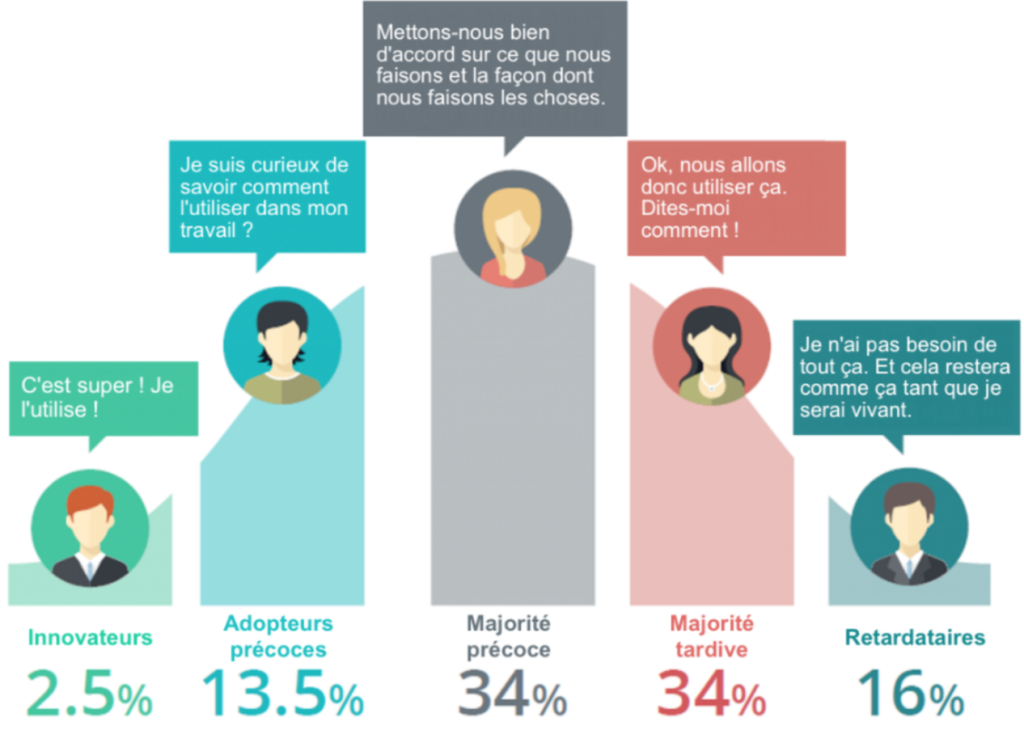
Finally, if we look at the positioning of move-to-cloud in relation to an innovation's adoption curve (often referred to as the Rogers curve), the move-to-cloud (hosting) market in France has left the world of "early adopters" to progress into the "early majority".

Tech for Business

Discover our expertise to support your challenges

Contact us

Let's talk about your projects and needs together

Further information

cabinet conseil tech

LE GUIDE INDISPENSABLE

DEVENIR UNE DIGITALLY OPTIMIZED COMPANY

Découvrez dans ce guide comment repositionner l’IT comme un véritable levier de valeur et non plus comme une simple fonction support.
Votre prochaine formation vous attend

INNOVEZ, TRANSFORMEZ ET ACCÉLEREZ

Découvrez nos formations pour accompagner les transformations du monde de l’IT et de l’IA.