The customer experience, like other aspects of marketing and customer relations, needs to be measured to assess its ROI. Our experts give you the 3 steps to follow to measure the ROI of your Customer Experience.

Summary
Measuring the customer experience helps us understand customer perceptions, identify the key drivers of satisfaction, and prioritize improvement initiatives. However, a customer experience measurement system should not be limited to tracking a single metric such as NPS, CSAT, or CES. The challenge is also to demonstrate the impact of the customer experience on the company’s performance.
To measure the ROI of the customer experience, it is necessary to link the various drivers of satisfaction to business metrics such as revenue, margin, customer loyalty, churn rate, and customer value. Analyzing customer data and statistical models thus makes it possible to identify the levers with the greatest impact and to simulate the effects of improving the customer experience.
This approach enables companies to shift from simply measuring satisfaction to actively managing customer performance. By identifying priority investments and their potential economic impact, measuring the customer experience becomes a decision-making tool and a driver of strategic transformation.
Contents
It is often necessary to demonstrate the economic impact of customer satisfaction to convince internal stakeholders of the value of putting the customer at the heart of the business, to evaluate budgets allocated to marketing or customer relations, and to assess the ROI of a project that impacts customer satisfaction…
To achieve this, it is possible to model this economic impact in concrete terms, by means of 3 steps.
- Map the drivers of customer satisfaction (or NPS) in relation to the company.
- Model the link between customer satisfaction (or NPS) and customer value (sales, margin generated...)
- Link the 2 models
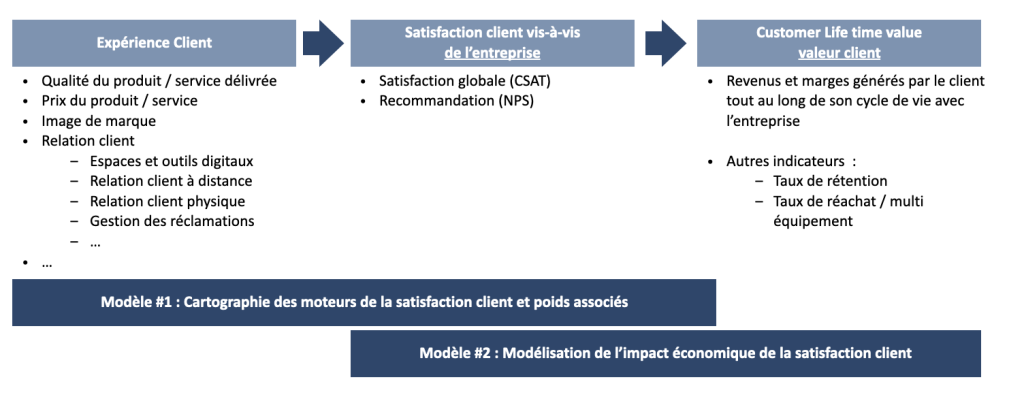
1. Map the drivers of customer satisfaction (or NPS) in relation to the company
Customer satisfaction depends on many criteria:
- The quality of the product/service delivered and the associated price
- Corporate image
- The relationship between the customer and the company: simplicity of paths (pre-sales / sales / after-sales), quality of digital spaces offered, efficiency in complaint management, quality of relations with face-to-face or telephone advisors.
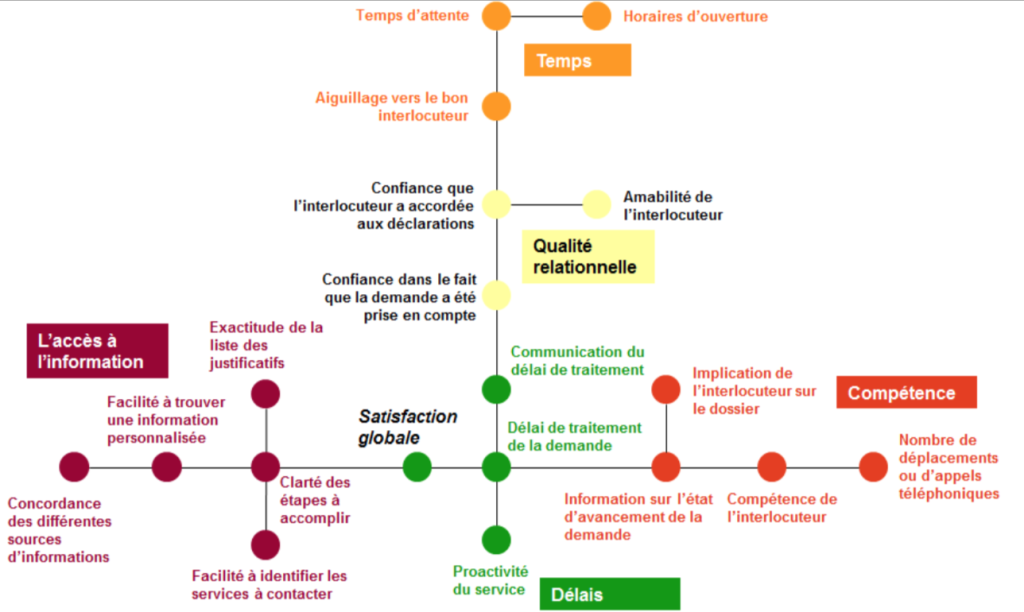
It is therefore important to be able to identify the weight and potential impact of these different criteria on customer satisfaction. To do this, it is necessary to carry out a survey of a representative customer base to measure overall satisfaction and customer satisfaction broken down by criterion.
Statistical analyses (linear regression, Bayesian model, etc.) are then used to model the impact of each criterion on customer satisfaction, using for example KANO model model (identification of criteria which generate very high customer satisfaction or which, on the contrary, can rapidly degrade customer satisfaction).
Bayesian analysis to dynamically measure the impact of the evolution of each criterion on all the components of the Bayesian network.
This analysis makes it possible to :
- Identify and organize all the "drivers" that structure customer perception
- Precisely quantify the impact of each driver on all the others and on the main component being measured (e.g. overall satisfaction).
- Simulate offer optimization or service quality improvements and measure their effectiveness
- Facilitate decision-making by prioritizing the levers to be used
- What are the priority levers for improving my NPS by 10 pts?
- Is it more efficient to invest in after-sales or to optimize the price of services?
- What impact does improving my customer service pick-up rate have on customer satisfaction?
2. Model the link between customer satisfaction (or NPS) and customer value (sales, margin generated, etc.).
Rely on research data and market studies
Example: Bain
By reducing attrition by 5%, the company can improve its net profits by between 25% and 85%.
Rely on the customer vision gathered during satisfaction surveys, including questions on re-purchase projections, and link these projections to customer satisfaction (or NPS).
Example:
80% of promoters say they renew their subscription / buy again vs. 50% of neutrals
Carry out statistical analyses based on internal customer knowledge (from a customer value perspective)
Example 1:
by customer segment, comparison of revenues generated between N-2 and N
- Promoters in year N-2
- Neutral in year N-2
- Detractors in year N-2
Example 2:
analysis of churn rates for promoters / neutrals / detractors
Fully modeling the economic impact of customer satisfaction is often a complex task. That's why it's good practice to identify an initial scope or indicator that can be implemented quickly.
Would you like to apply these models to your business? Contact us to find out more.

Customer Experience Consulting

Customer Experience in Insurance: Why Delegating Management Is Becoming Strategic
In an ever-changing insurance industry, where operational efficiency, flexibility and cost control remain the watchwords, delegated management is a key pillar of our strategy.

How do you define a Customer Experience framework?
You’re (probably) familiar with the product framework and the customer relationship framework, but are you familiar with the customer experience framework? Yet the customer experience framework is essential today
How do you build an effective customer experience strategy?
To ask the question of customer experience strategy is to recognize that taking account of the customer experience has gradually spread throughout BtoC and BtoB companies.
Frequently Asked Questions
How can we measure the customer experience?
What are the key KPIs for measuring customer experience?
How do you calculate the ROI of the customer experience?
Why should you turn to iQo to improve your customer experience?
iQo helps companies define and transform their customer experience, from strategy to operational implementation. Our approach combines strategy, design, data, journey analysis, and organizational transformation to create simpler, more consistent, and more distinctive experiences. With its proprietary CX-iD methodology, iQo helps its clients define their experience goals, identify moments of truth, design target customer journeys, and build a transformation roadmap aligned with business priorities.