Vous connaissez (sans doute) le référentiel produit ainsi que le référentiel de relation client, mais connaissez-vous le référentiel expérience client ? Pourtant, le référentiel de l’expérience client est aujourd’hui fondamental pour s’assurer de cadrer et encadrer les démarches visant à améliorer l’expérience client. Nos experts Marketing & Expérience Client vous donnent les clés pour définir votre référentiel de l’Expérience Client.

Contents
Why define a customer experience repository?
Companies today face 2 key challenges:
- How can we ensure a consistent customer experience across the different customer journeys, and across the company's different offerings?
- How to ensure that the projects of all Customer Experience, Marketing and Operations teams take account of customers' needs and expectations
Building a customer experience repository can bothformalize the desired ambition (and thus provide a sense of direction) and concretely share the targeted objectives.
En réponse à ces enjeux, construire un référentiel de l’expérience client peut permettre à la fois de formaliser l’ambition souhaitée (et ainsi donner le sens) et partager concrètement les objectifs visés.
Before embarking on the development of a customer experience repository, it is essential to ask yourself the following key questions:
- What should it contain?
- Does the standard define strategic ambitions and/or operational objectives?
- Est-il générique et transverse à l’ensemble des activités de l’entreprise ? Peut-il se décliner selon les parcours, les offres et les types de clients ?
How to build a Customer Experience repository?
Here are a few ideas to help you build your customer experience repository:
- Define the level of ambition of the reference framework: strategic and/or operational
- Define the components of the reference framework: customer promise, standards, postures and rituals
- Define the scope of the customer experience repository: offers, routes and/or customer typologies
1. Define the level of ambition of the Customer Experience repository
First of all, designing a customer experience repository means deciding on its orientation. It can be strategic and/or operational.
- A more strategic frame of reference will define the key principles of the customer experience that the company wants its customers to enjoy. This type of framework gives meaning to the teams and makes them responsible for the implementation of the different offers and customer journeys.
- An "operational" frame of reference defines the actions to be taken by teams to achieve the targeted levels of customer experience and satisfaction.
Cependant, un référentiel peut également combiner les 2 volets. C’est par exemple le cas du référentiel de l’expérience client d’un acteur du transport ferroviaire en France.
Illustration: the customer experience repository of a French rail operator
This reference framework is built on several levels, from the most strategic to the most operational.
On the strategic side, the customer promise is defined as follows:
- More fluid with digital,
- More comfortable,
- Enriched by services.
This promise serves as a framework and can be broken down more operationally into actions to be implemented at different stages of the traveller's journey, for example :
- Ensure cleanliness of sanitary facilities at train departure
- Have the controller make an on-board announcement about baggage stowage
- Provide an on-board Wifi connection enabling access to a website in less than 5 seconds
2. Define the components of the Customer Experience framework
Next, let's take a look at the 3 components of a customer experience repository.
- Visit customer promise is one or more qualitative commitments formulated by the brand for its customers, relating to the experience or quality of the products and services offered. It reflects what the company wants its customers to say about itIt's a way of announcing what the customer will experience in his relationship with the company.
Examples: Darty: "Le nouveau contrat de confiance : Prix, Service, Conseil, Durabilité"; Paypal: "Le paiement en ligne, simple et sécurisé".
- Visit standards reflect in quantitative terms the level of service quality the company wishes its customers to experience. Defining standards makes it possible to translate the promise into quantified objectives. Integrating standards into the repository makes it easier to measure performance liée à l’expérience client.
The challenge is to define a limited number of priority customer experience standards, to enable effective appropriation by teams. Even on a large scale, the multiplication of standards makes it difficult to understand and prioritize internal efforts towards what is really important for customers.
Examples: Respond to 90% of requests within 2 working days; A customer should not wait more than 5 minutes on the telephone.
- Relational postures are attitudes adopted by company employees in their interactions with customers, and constitute the company's "relational signature". Relational postures are then translated by teams into words / gestures / rituals to be applied in their daily work.
It is entirely possible to integrate all 3 components into a single framework, as the most mature companies do. However, a first step could be to develop a repository with one component, and add to it as you go along.
Quels types de référentiel client ?
KEY OBJECTIVES
- More strategic, they set out the main principles of the customer experience.
- Then it's up to the offers, channels and operational teams to put them into practice.
- They therefore help to give meaning.
ADVANTAGES
- Simple and easy to use
- Empowering teams (marketing, operations) in implementing
- Adaptable to all channels (face-to-face, digital, telephone)
POINTS OF ATTENTION
- More strategic, they set out the main principles of the customer experience.
- Then it's up to the offers, channels and operational teams to put them into practice.
- They therefore help to give meaning.
KEY OBJECTIVES
- They enable us to implement continuous improvement by defining objectives and associated measurement methods.
ADVANTAGES
- Clearly detail the customer experience that customers need to have
- Set objectives for offers/distribution channels
- Easier to measure
- Standardize the customer experience
POINTS OF ATTENTION
- The number of standards can quickly increase over large perimeters
- More complex, less agile evolution
- They therefore help to give meaning.
KEY OBJECTIVES
- They generally help to develop interpersonal skills when interacting with customers.
ADVANTAGES
- Suitable for activities involving frequent interaction between customers and employees
POINTS OF ATTENTION
- Poorly adapted to the digital customer experience
For example, the postures defined by one of France's historic banks are "Enthusiastic, curious, reassuring".
Rituals are the actions / attentions (gestures, speeches, etc.) put in place by the company for its customers to implement the promises, standards and postures operationally throughout the customer journey. An example of a ritual in place at Nespresso is free coffee in the boutique!
3. Define the scope of application of the Customer Experience repository
The third dimension of the customer experience framework to be defined is its scope: the components of the framework can be applied and adapted according to the different offers, the stages of the customer journey and the associated channels (website, points of sale, customer service, etc.), and/or the types of customers targeted.
The challenge is to strike a balance between :
- A general repository, common and applicable to all the company's offers and customers, but potentially not very specific if the company has a wide range of offers.
- A detailed repository adapted to all situations and all types of customer, but potentially cumbersome and less easily appropriated by teams.
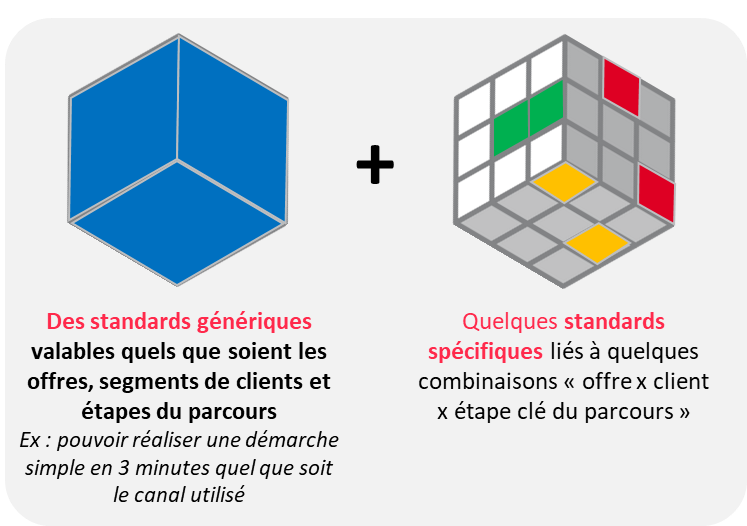
To avoid this pitfall, for example, a company might decide to implement a majority of common standards, supplemented by a few specific or adapted standards for key offers, moments or customer typologies.
Example: the scope of a French bank's customer experience repository
The customer experience repository of one of France's historic banks sets out key service rituals according to the moment in the customer journey. For example:
I have an appointment with my advisor.
A drink is offered on arrival and if I have to wait, a comfortable lounge is provided.
I'm greeted unexpectedly, without waiting, even by phone or e-mail.
Everything (a look, a smile, interrupting internal conversations...) must be done to welcome the customer as soon as they arrive, so that they can choose whether to wait or come back later.
I'm opening an account or visiting the branch for the first time.
The advisor takes the customer on a tour of the branch to show them the services.
I'm here to solve an urgent problem.
As soon as the difficulty is announced, the advisor reassures the customer of his role, so that he is convinced that the advisor is the shortest route to the solution.
Best practices for the successful implementation of your customer experience repository
A customer experience repository is not simply a theoretical model to be designed by Customer Experience teams, but a key tool to be widely used by teams whose actions can impact the customer experience: for example, Marketing, Operations / Sales.
Here are a few best practices for turning your customer experience repository into a useful tool that can be used throughout your company:
- Start from customer expectations: any customer experience benchmark must start from customer expectations, which will guide the definition of target standards and legitimize the expectations defined by the benchmark.
- Involve the business units to encourage buy-in: this can be done upstream, for example, by involving representatives in the benchmark design project, or downstream by positioning the Customer Experience Department as a support to other teams in improving results with regard to the benchmark standards.
- Set up a measurement system and specific governance: these must enable us to monitor and share the achievement of customer experience standards, and to ensure that they evolve over time.
- Promote certain elements of the standard externally: the standard is an internal tool, but the company may decide to communicate externally about the promise or key standards for customers, or even to label them.
What are the strategies for designing and implementing a customer experience repository?
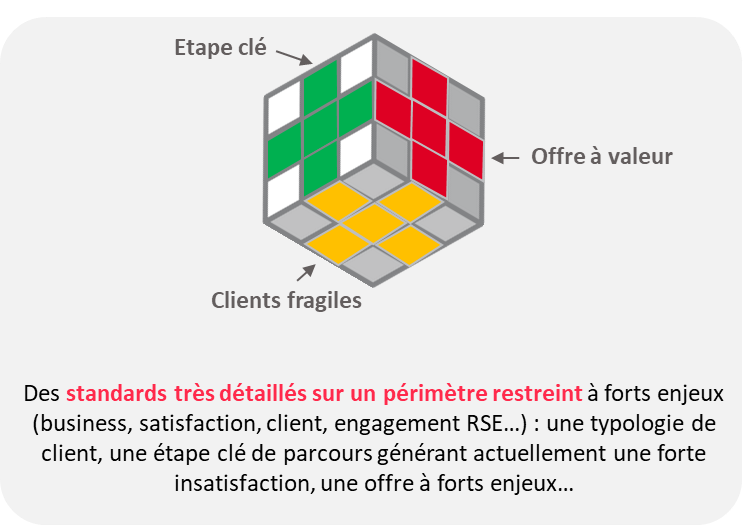
To strike the right balance between a generic and a detailed repository, it's important to clearly define the scope and level of application. Two different solutions are possible:
Solution 1: Treat all cases with common standards to guarantee uniformity of experience & define some specific features
Solution 2: In-depth treatment of a restricted, high-stakes perimeter to concentrate efforts there

Every quarter, you'll receive the iQoScope by email, featuring feedback and best practices from our Marketing & Customer Experience projects.
Further information

3 steps to measuring Customer Experience ROI
L’expérience client, au même titre que d’autres dimensions du Marketing et de Relation Client, doit être mesurée pour en évaluer le ROI. Nos experts vous

Why should listening to customers be a key element of your customer experience strategy?
Listen to build loyalty: what customer listening system should you put in place to boost your customers' experience and satisfaction? At a time when

How do you build an effective customer experience strategy?
Asking the question of customer experience strategy means recognizing that taking customer experience into account has gradually spread throughout companies.