Along with lead management, customer loyalty and retention are two key elements of any effective marketing strategy. Against a backdrop of ever-increasing competition and an increasingly tense economic climate (lower margins, more volatile and demanding customers, etc.), companies need to redefine the contours of their customer relationships.
While acquiring new customers is a top priority, customer satisfaction and loyalty are just as important, if not more so. We explain in detail why.
Article summary
Customer loyalty is, and will continue to be, essential for companies
With more volatile customers (better information, use of comparators...) in both BtoC and BtoB, increased competition (disruption in all traditional markets...) and simplified cancellation procedures (simplification of processes by legislation, assumption of responsibility by the new supplier...), building customer loyalty is essential to any marketing strategy.
What are the objectives of a customer loyalty strategy?
- Better amortization of customer acquisition costs
- Lower management management costs
- Less sensitivity price sensitivity
- An increase in customer value (re-purchase, customer seniority...)
- From recommendation effects (word of mouth, customer ambassadors...)
There are a number of questions to ask when developing your customer loyalty strategy
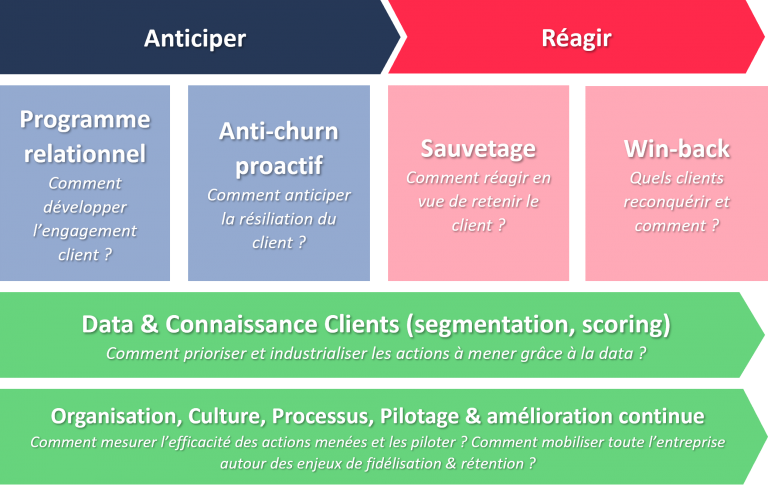
- How to developcustomer commitment?
- How to anticipate customer termination?
- How do you go about retaining customers?
- Which customers to win back, and how?
- How do you prioritize and industrialize the actions to be taken?
- How do you measure their effectiveness and manage them?
- How can you mobilize the entire company around the challenges of loyalty & retention?
What are the possible levers for your customer loyalty strategy?
Customer satisfaction remains an essential but not always sufficient condition for ensuring customer loyalty.
- Act on the sources of customer dissatisfaction: identify and categorize customer irritants, assess their degree of importance and prioritize them, understand the causes and consider ways of resolving them. Find out more in this article.
- Propose relational programs to create brand loyalty: work on moments of life/truth with high emotional stakes; offer additional services or relational devices with value; innovate in the way customer loyalty is rewarded (in particular by using responsible levers consistent with the brand's territory); prioritize and simplify the resolution of certain disputes/complaints... all these actions can be based on segmentation by customer value in order to prioritize and personalize these approaches.
- Develop customer commitment: work on customer communities and put customers in touch with each other, set up customer listening systems
- Develop multi-equipment: by using customer appetence scorings for services or offers, and by setting up optimized cross-sell and up-sell paths.
To limit churn, you need to be able to act proactively and effectively on the risk of customer departure.
- Refine detection of customer departure risk: build a customer termination risk score (based on contractual data, customer relations, consumption, quality of service provided, etc.); identify risk-related behaviors (customer web browsing on the company's website and comparators, customer requests for contractual documentation, etc.).
- Configure CRM tools with retention in mind: ensure that the available data contributes to the risk score, and enable customer-facing teams to visualize the risk level of each customer.
- Define "top risk" actions: define specific action plans for each of the customer's "sensitive" moments (end of a promotional offer, sending of an expiry notice, contract suspension, etc.) or in connection with circumstances that could have an impact on the customer (promotional offer from a competitor, termination of a contract within the household, etc.).
- Work towards contract convergence: by promoting the pricing and usage advantages of multi-equipment (as a brake on attrition).
- Work with partners who specialize in managing key life events (e.g. moving house), comparing offers or cancelling contracts, to enhance proactive detection of the risk of customer departure.
- Define the level of generosity you are willing to make to retain a customer: assess customer value, the value of a household, the customer's power to influence (especially in B2B), determine the financial effort possible, but also imagine non-financial commercial gestures (complementary services, etc.).
- Set up cancellation paths that capture the reason for the departure and maximize opportunities for dialogue with the customer, so that appropriate rescue actions can be taken (e.g., highlighting a dedicated telephone number on the website pages dealing with cancellations, etc.).
Once the customer's request for cancellation has been received, a rescue opportunity
can be transformed into a real opportunity.
When a reasoned exchange is possible and when a suitable rescue device is in place, the customer can be retained thanks to rescue actions:
- Carry out hot rescue actions by testing different methods: channels, call-back time during the withdrawal period, scale of generosity and commercial actions.
- Prioritize customers to focus on according to customer value and reason for termination
- Set up a unit dedicated to retention, with employees equipped with retention tools (sales pitches, sales gestures, etc.), trained in the relational attitudes to adopt, and objectified / remunerated according to appropriate KPIs.
A former customer who knows you and whom you know is a potential
prospect to win back.
It is therefore advisable to work with this former customer as a potential prospect over the long term (in compliance with the RGPD):
- Prioritize the most "catch-up" and high-potential customers (previous level of satisfaction, length of previous contract, age of termination, etc.). The creation of a catch-up score on the basis of customers who have resubscribed with the company can feed this targeting.
- Get back in touch at opportune moments: end-of-contract anniversary, move, launch of a new offer, etc.
Capitalize on customer information to personalize communication (customized quotes, etc.). - Recall the company's strengths and highlight the improvements made since his departure
- Keep it simple and direct: a former customer's attention span is limited
- Simplify the process for customers wishing to re-engage with the company
- Pay special attention to customers once they have been "won back": keep a close eye on changes in their contractual terms and conditions, on service quality, on the rhetoric used...
Ensure that the customer retention and loyalty system can be steered and improved on an ongoing basis
- Draw up a business case for the system and update it annually
- Define KPIs and internal lighting indicators (capacity to deliver, changes in offers/prices...)
- Set up a system to manage loyalty & retention initiatives
- Set up a dedicated governance structure involving all departments contributing to retention initiatives.
- Study the evolution of churn rates in relation to the context, the competition and the customer segment under study.
- Take stock of customer knowledge and identify ways of improving it (purchasing, open source, etc.), particularly with a view to scoring.
Align the company with customer loyalty issues to maximize the impact of actions taken.
- Make employees in contact with the customer a surface for detecting and reinforcing the risk of customer departure
- Set up a simple system to listen to customers, identify actions to improve satisfaction and prevent attrition
- Implement training and team-building plans, not only for employees dedicated to retention (retention unit), but also for other staff in contact with customers
- Mobilize the company at all levels and communicate regularly on the retention strategy and the KPIs monitored
Illustration: building a comprehensive customer loyalty & retention program to effectively combat customer attrition
Mission feedback: customer loyalty strategy
How can iQo support your customer loyalty marketing strategy?
iQo is a new player in the consulting sector, whose mission is to "unleash collective genius to co-construct desirable futures".
Our firm offers a unique approach to co-construction with our customers ...
- We advocate the hybridization of skills and know-how
- We offer you small, agile teams (squads) that are sincerely committed to working alongside you, as an extension of your teams.
- We are "makers" and offer concrete, results-oriented solutions tailored to your specific needs.
…and committed: We are a mission-driven company, ISO 14001-certified, and have collaboratively developed 23 commitments to create a positive impact with our employees.
Our Marketing & Customer Experience offer is structured around 5 themes:
- Customer-oriented transformation
- Customer strategy
- Innovation customer experience
- Marketing & sales efficiency
- Customer relationship efficiency
We have developed specific expertise in defining, implementing and measuring customer loyalty and retention strategies.
We have developed specific expertise in defining, implementing and measuring customer loyalty and retention strategies.
Also read about marketing and customer loyalty

Vivatech: 5 Startups Focused on the Customer Experience
Discover the 5 startups we spotted in the fields of marketing, customer experience and customer relations at Vivatech 2021. These
10 keys to an efficient marketing organization
In both BtoB and BtoC markets, the marketing organization and its perimeter must evolve to cope with the rapid and continuous changes in their environment: A